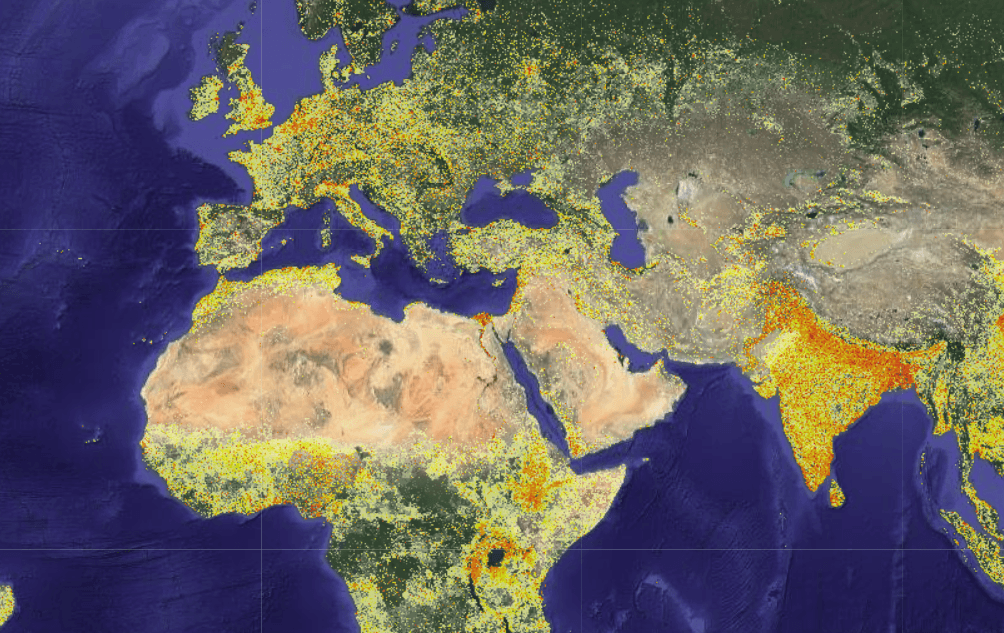
We are incredibly pleased to release the WorldPop Global 2 Population Counts with age and sex structures.
The dataset provides 100-meter spatial resolution, covering estimates from years 2015-2030, offering dramatically finer detail than traditional population grids. More importantly, WorldPop uses a settlement-constrained modeling approach, which assigns population only to locations where human settlements exist.
Instead of spreading population evenly across land, population values are concentrated within areas that contain buildings and infrastructure. This produces a much more realistic representation of where people actually live.
This increased precision brings a level of confidence and accuracy to a number of fields including:
competitor coverage analysis
market sizing
For example, when measuring population within a trade area or potential franchise territory, higher-resolution population data can reveal clusters of population that might otherwise be hidden inside large grid cells.
Population Explorer users can now select WorldPop directly within the platform when performing population analysis.
This allows users to measure population using either the traditional LandScan dataset or the new WorldPop dataset, depending on the level of spatial detail required.
WorldPop is now available to all Pro and Enterprise Population Explorer users.