Introduction - Jakarta retail and franchise site selection guidance
Jakarta is one of the fastest-growing urban markets in Southeast Asia, but nearly half of its population is not within a 15-minute drive of major retail clusters.
This creates a rare dynamic: a dense, growing city where retail demand continues to outpace coverage.
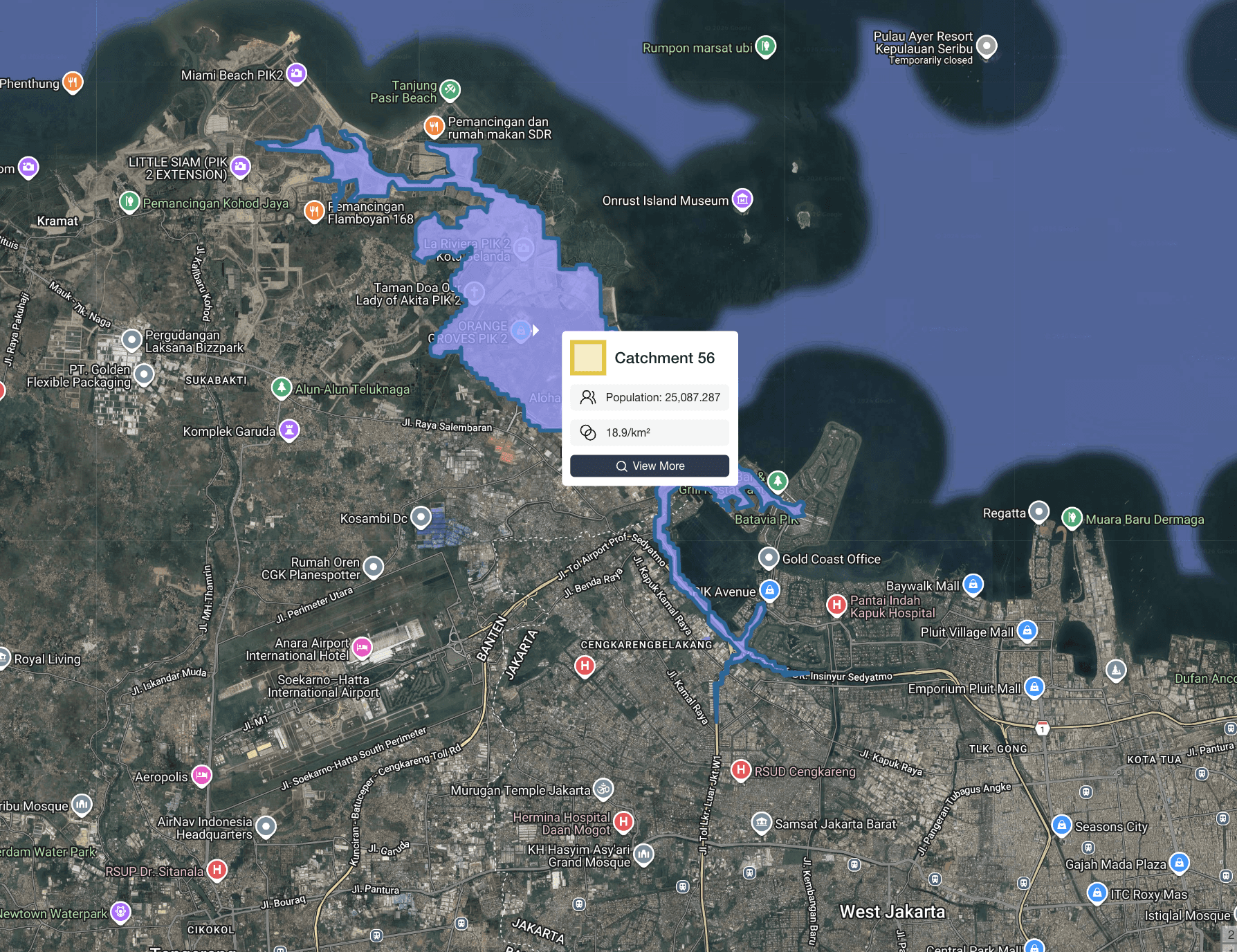
In this analysis, we used drive-time catchments, population forecasts, and retail density data to identify where the strongest expansion opportunities exist.
Jakarta Retail Coverage Gaps and Underserved Areas
To understand where new retail opportunities exist, we first evaluated how much of Jakarta’s population is currently served by existing retail clusters.
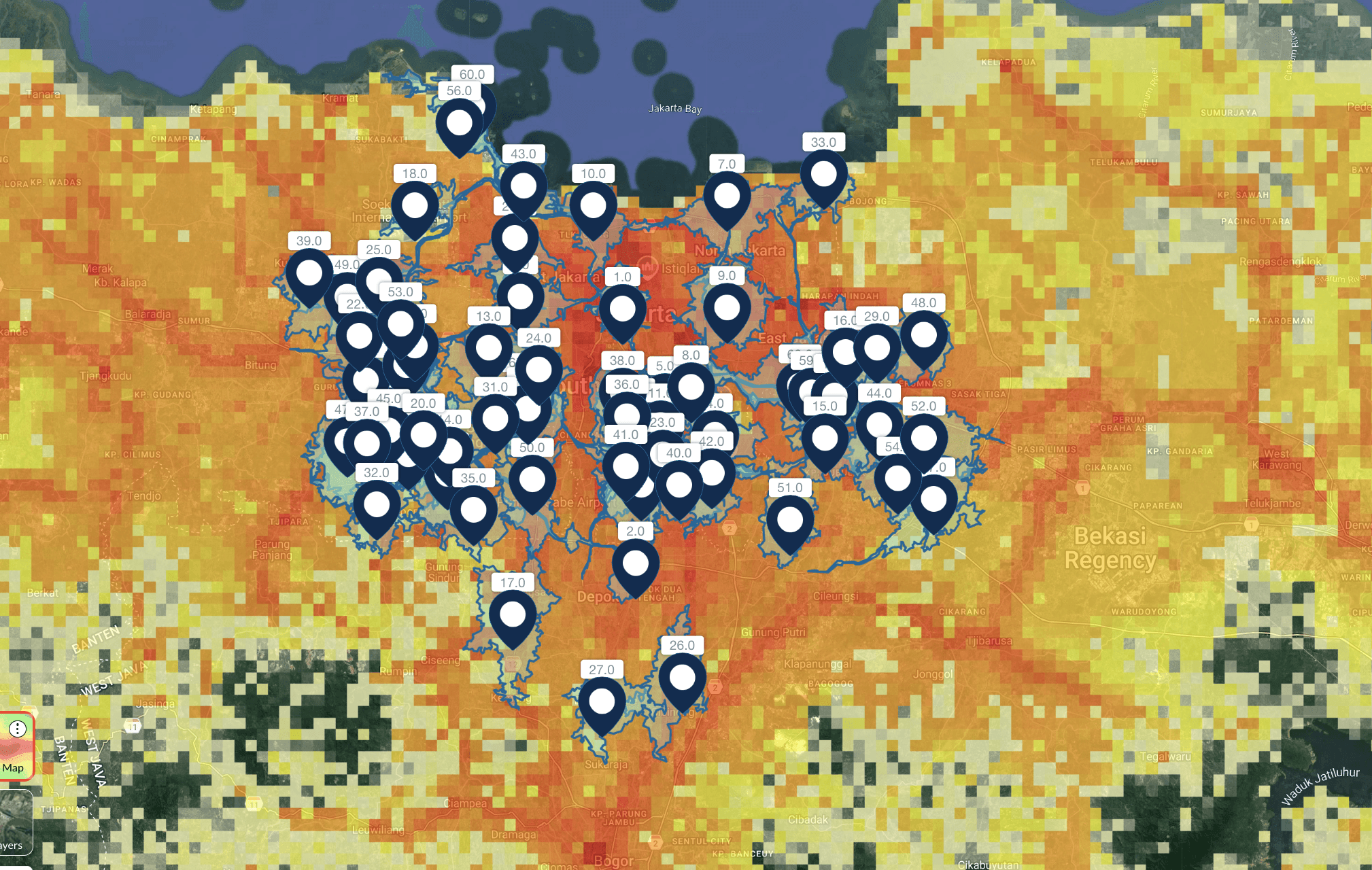
Using 15-minute drive-time catchments around 62 high-density retail clusters, we compared covered population against a broader Jakarta boundary.
The results are striking:
Only ~56% of Jakarta’s population is within a 15-minute drive of major retail clusters
Nearly 10 million people remain outside core retail coverage
These uncovered areas are not low-density, they are dense urban corridors with meaningful retail demand
This is a classic case of retail whitespace, areas where population density is high, but retail presence has not scaled proportionally.
For franchisors and retail operators looking to capitalize on territory opportunities, or identify optimal locations for new retail sites, these underserved zones represent some of the most compelling expansion opportunities in the city.
Where Retail Demand Is Growing Fastest in Jakarta
Population growth across Jakarta is steady but highly uneven.
Using WorldPop population forecasts (2025–2030), we analyzed growth across all retail catchments and found that:
The majority of catchments are growing
However, a small number of areas are driving disproportionate increases in future demand
One catchment shows over 36% projected growth, significantly outpacing the city average
This suggests that retail demand is not expanding uniformly, but instead concentrating in specific growth corridors, particularly toward the edges of existing retail coverage.
These areas are especially important for expansion planning, as they represent:
emerging residential density
increasing accessibility
and future retail demand that may not yet be fully served
Retail Density and Underserved Catchments
Population growth alone does not determine opportunity. What matters is how it compares to existing retail supply.
To evaluate this, we analyzed retail density relative to population across Jakarta catchments.
A simple but powerful metric is: People per retail location
This measures how much population each retailer is effectively serving.
Across Jakarta:
Some catchments show high retail density, indicating competitive or saturated environments
Others show high population relative to retail, indicating potential under-supply
The most attractive opportunities tend to be areas where:
population density is high
retail density is relatively low
and growth remains strong
These catchments represent imbalanced trade areas, where demand may exceed current supply.
Daytime Demand and Ambient Population
Residential population does not fully capture how demand behaves in a city like Jakarta.
To account for this, we compared WorldPop residential population with LandScan ambient population, which reflects how people are distributed across a 24-hour period.
This helps identify areas where daily inflow of workers or visitors increases demand, and commercial activity may be elevated.
In several Jakarta catchments, ambient population significantly exceeds residential population, indicating strong daytime demand potential.
These areas are particularly well suited for:
quick-service restaurants (QSRs)
convenience retail
and high-frequency, time-sensitive formats
Best Retail Expansion Areas in Jakarta
By combining:
population growth
retail density
and ambient demand
we identified a set of catchments where multiple signals align.
These areas represent some of the best retail and franchise expansion opportunities in Jakarta.
Top opportunity catchments (selected):
Cluster 9 – High population density with relatively limited retail presence, indicating strong neighborhood-level demand
Cluster 8 – Dense and growing, but retail coverage has not kept pace
Cluster 38 – Strong ambient population signal combined with balanced growth
Cluster 4 – Above-average growth with relatively low retail density
Cluster 53 – Consistent performance across growth, density, and supply
Importantly, these are not necessarily Jakarta’s largest or most established retail areas.
Instead, they represent emerging and under-served catchments, where:
demand is growing
competition is moderate
and expansion potential is high
What This Means for Retail and Franchise Expansion
For franchisors and retail operators, Jakarta presents a unique opportunity:
A large, dense population base
Uneven retail distribution
Strong localized growth
and pockets of elevated daytime demand
Rather than focusing solely on established retail corridors, this analysis highlights where supply and demand are most out of balance, often the clearest signal of opportunity.
How to Analyze Prospective Retail Locations
Population Explorer provides critical demographic, competitor and ally intelligence for every country in the world, giving your unparalleled confidence in selecting competitive, profitable locations for your new retail or franchise location.
You can import or search for your new locations, measure population and competitor density within a driving distance, compare multiple locations and more.
Start here and approach your new markets with more confidence.
Download the Full Jakarta Retail Expansion Report
The complete report includes:
full rankings across 62 retail catchments
detailed methodology
and deeper insights into population, density, and demand
Download the full Jakarta Retail & Franchise Expansion Report below