At What Point Does a Franchise Need Territory Mapping?
Franchise territory mapping is one of those things that is easy to postpone. Early on, that can be completely reasonable. A young franchise system has more urgent problems than perfecting a map. The brand may still be proving demand, supporting its first franchisees, refining operations, or figuring out which markets are even worth entering.
At that stage, detailed franchise territory mapping can feel like overkill. It sounds expensive. It sounds technical. It sounds like something to deal with later, once the system is larger and there is more time.
Sometimes that instinct is right. But it's crucial to know when “later” has arrived.
Mapping can feel harder than it needs to be
Generally, franchisors are not ignoring territory planning because it seems pointless. It just feels less critical than other pressing priorities. Early franchise growth is busy. There are sales calls, onboarding issues, training problems, operations questions, legal documents, franchisee support, and capital constraints. If you can close a franchisee with a less-than-rigorous Item 12, why spend the extra time?
Reason #1 to map territories: Territory decisions compound over time
Sometimes, what can be forgiven in the short term will bear out compounding consequences in the long term. A simple geometry analogy of an angle with radians is very helpful here: at the start, two lines moving in slightly different directions may not look very far apart. Extend them far enough, and the gap becomes much larger.
Franchise territory decisions work the same way. In the early stages, a rough Item 12 may be good enough. Many scenarios arguably will not benefit from an over-investment in territory maps. Some of these include:
operating only a handful of locations
still proving unit economics
concentrated in one local market
not granting meaningful territorial exclusivity
expanding slowly without aggressive development plans
not yet facing overlap, encroachment, or market-pricing questions
Over time, though, the opportunity costs of those decisions will mount.
Reason #2 to map territories: Territory is your asset
In actual fact, the map reflects your primary asset as a franchisor. Each territory, and the customers contained within, are the key to your cash-flow. The key to your success. Every person inside a protected territory represents potential future demand. One more potential revenue stream.
Have you sold one territory containing 100k potential buyers, and another territory containing 500k potential buyers, both for the same price?
The sooner a franchisor understands how much demand it is protecting, how much expansion room remains, and how territory quality varies from one market to another, the more profitable the system becomes over the long run.
Reason #3 to map territories: Early Item 12s can create precedents
Another reason to think about mapping earlier is that early territory decisions can be difficult to unwind.
An Item 12 may feel temporary when the system is small. In practice, it can become part of how franchisees understand the deal they bought into. Once a brand has granted certain protections, market sizes, or boundary logic, changing course can be slow and sensitive.
Franchise territory mapping has changed
A lot of franchisors still picture territory mapping as a consultant-heavy process. That was a fair assumption for a long time.
Historically, mapping often meant expensive outside help, complex GIS software, static demographic reports, and long turnaround times. For a non-technical franchisor, it could feel like a specialized project rather than a normal business workflow.
That has changed over the last two decades. SaaS tools are much easier to use. AI has reduced some of the learning curve. Backend mapping services are more mature. Demographic data is better, faster, and available at higher resolution.
In plain terms, a franchisor does not need to spend weeks learning complicated software or pay a consultant just to start making better territory decisions.
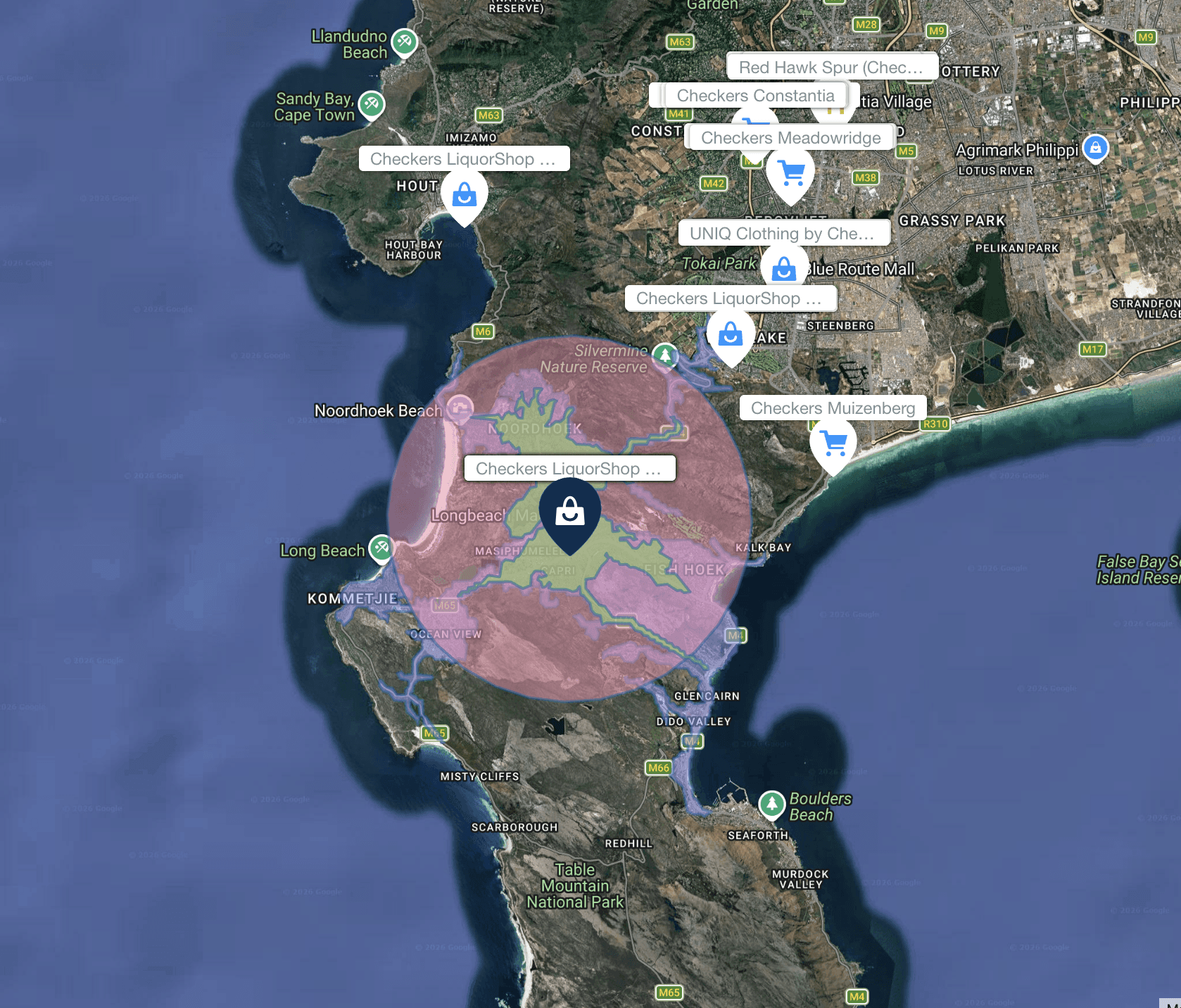
With Population Explorer, you can map a franchise territory in less than two minutes. You can draw a boundary, generate drive-time areas, compare population and income, evaluate nearby businesses, and use satellite-derived demographic data without needing a technical background.
If you want to see how quickly it works, start here
What improves once you start mapping
Good territory mapping does not guarantee successful franchise expansion. It does, however, reduce avoidable uncertainty.
A mapped territory gives the franchisor and franchisee a clearer view of what is being protected, what demand exists inside the boundary, and how that territory compares with other markets.
The benefits usually show up in a few practical areas:
Franchise sales become easier to support with data instead of broad market claims.
Territory pricing becomes more rational because markets can be compared more consistently (there are three fundamental factors that affect territory performance)
Franchisee confidence improves when protected areas are clearer and better explained.
Expansion planning becomes less reactive because whitespace is visible earlier.
Overlap and cannibalization risks are easier to identify before they become disputes.
Leadership can see which markets are strong, weak, underbuilt, or oversold.
The point is not to make territory planning more complicated. The point is to make expansion decisions easier to defend.
So when does a franchise need territory mapping?
A franchise probably does not need rigorous territory mapping on day one. It does need it before territory decisions become difficult to reverse.
That moment usually arrives when the brand starts selling protected markets, comparing expansion opportunities, entering multiple metros, or trying to explain why one territory should be priced or structured differently from another.
So, in general:
If a territory is just a placeholder on a map, the urgency is low.
If a territory is part of the economic promise being sold to franchisees, the urgency is much higher.
Ready to start?
You can create franchise territories yourself in Population Explorer, or you can send us your locations and have us mock up a territory map for you.
Same price, data and quality outputs.
Choose whichever path is easier, and we’ll help you get it done.