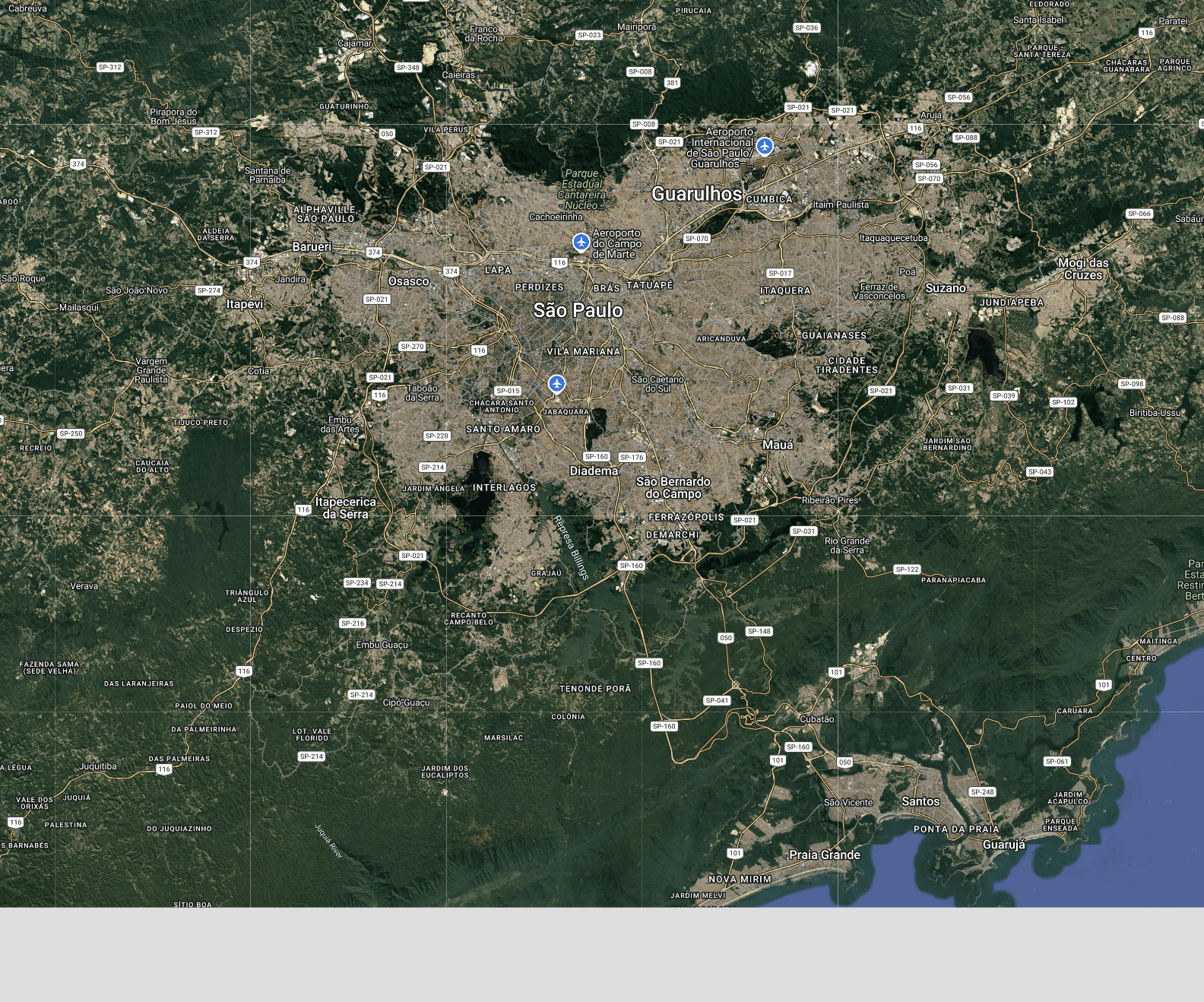
As customer density, commuting behavior, and population growth shift across a metro, retail concentration does not always adapt at the same speed. In some cases, the strongest forward-looking demand signals begin appearing outside the city’s most established retail structure. That pattern appears in São Paulo.
Using high-resolution population forecasts, retail POI analysis, ambient population modeling, and drive-time catchment mapping, we evaluated how São Paulo’s current retail footprint aligns with evolving customer demand patterns across the broader metro. The result was not a simple “underserved market” story. Instead, several secondary corridors emerged where:
customer density is strengthening,
ambient activity is growing or elevated,
and competitive pressure remains comparatively moderate relative to São Paulo’s dominant retail centers.
For retail site selectors and franchisors evaluating territory expansion in Brazil, these types of corridors can become strategically important long before they resemble fully mature commercial hubs.
Evaluating retail opportunity beyond São Paulo’s core commercial structure
Many retail site selection strategies focus primarily on existing retail concentration. This strategy is defensible, as dense commercial corridors often reduce uncertainty:
customer demand is visible
infrastructure already exists
retail performance has already been partially validated by surrounding operators
However, this approach can also lag forward-looking indicators. If retail investment clusters where retail already exists, it risks overlooking customer growth and activity patterns broadening elsewhere across the metro.
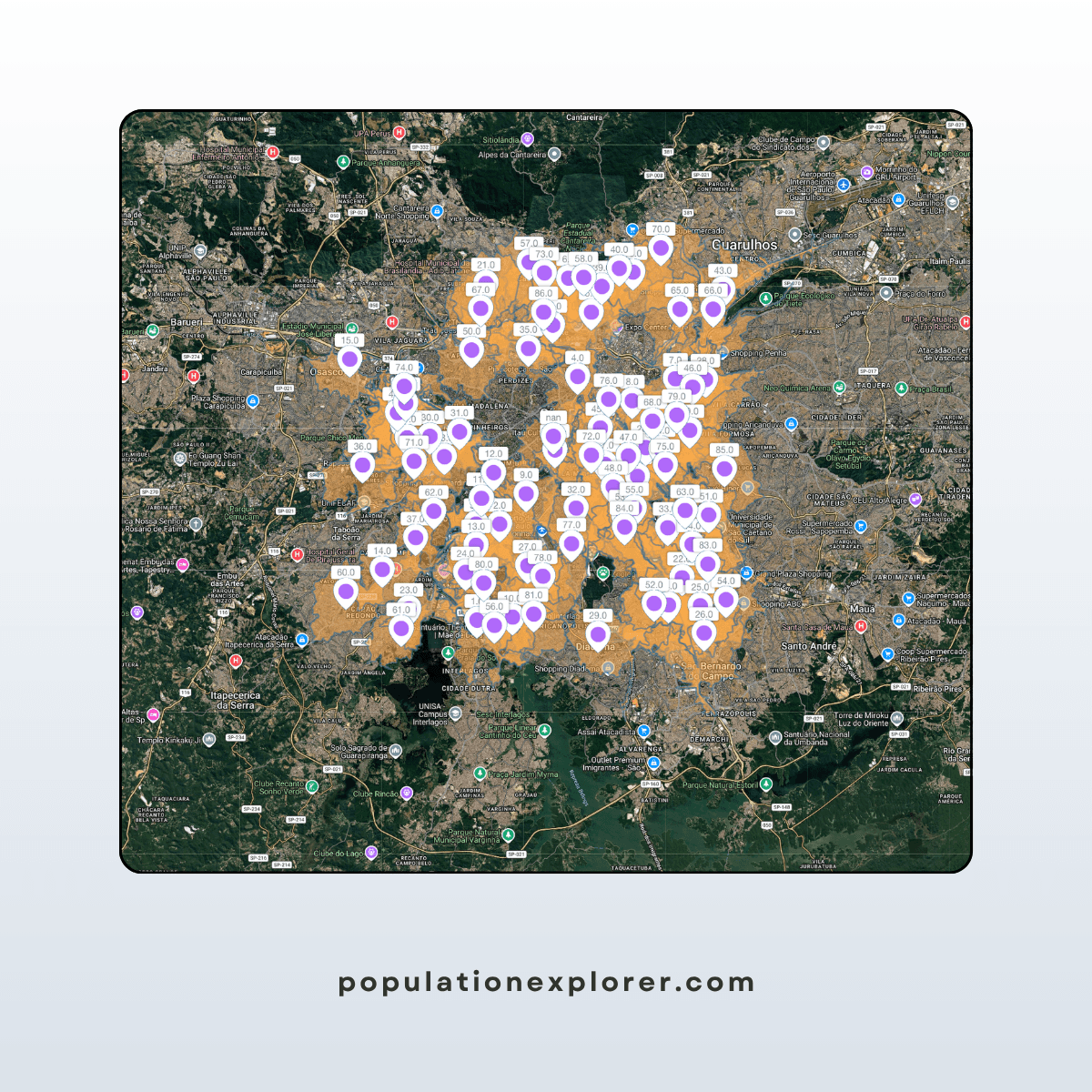
To better evaluate this dynamic, we grouped São Paulo retail locations into major commercial clusters and generated drive-time trade areas around each corridor. We then evaluated every catchment using three core territory evaluation indicators:
1. Customer Density
Current and projected population concentration using WorldPop forecasts.
2. Competitive Pressure
Retail density relative to surrounding population.
3. Ambient Activity
LandScan ambient population patterns reflecting daytime movement and non-residential demand.
Together, these indicators create a more practical framework for franchise territory analysis and retail expansion planning than population totals alone.
Retail coverage in São Paulo already appears extensive
Unlike some emerging retail markets, São Paulo does not exhibit significant gaps between population density and retail infrastructure. Large portions of the metro already fall within the reach of established commercial corridors.
At the same time, several important whitespace indicators remain significant:
roughly 9.47 million people worth of ambient population falls outside modeled retail catchments
more than 8 million residential residents remain outside existing trade areas
uncovered population is projected to continue increasing through 2030
Importantly, these 'uncovered' areas are not uniformly peripheral or low-density. Several secondary corridors show positive residential growth trajectories and elevated ambient activity relative to residential population. These factors bear significant impact on the future performance of potential retail sites within these corridors.
Secondary growth corridors are beginning to matter more
After excluding São Paulo’s dominant central retail core from comparative analysis, notable patterns emerged across several secondary corridors.
A number of these areas combine:
positive projected population growth,
elevated ambient population differentials,
and more moderate retail density relative to the city’s largest commercial hubs.
In practical terms, this suggests that parts of São Paulo’s future demand structure may continue broadening outside the city’s historically dominant retail centers. That does not mean established commercial corridors are weakening, but it does suggest that some secondary trade areas may be accumulating customer density faster than surrounding retail competition is adapting.
For franchise territory planning, this creates a meaningful strategic distinction.
The strongest long-term territory opportunities are not always located where retail concentration is already highest. In many cases, they emerge where customer density is strengthening, competitive pressure remains manageable and yet commercial ecosystems have not yet fully matured.
What the data suggests about retail competition in São Paulo
One of the clearest patterns across the analysis was the heterogeneity of competitive pressure. São Paulo’s dominant retail corridors remain exceptionally concentrated relative to much of the surrounding metro. Outside these mature hubs, however, several catchments continue showing strong customer density, elevated ambient activity and comparatively thinner retail concentration.
This creates a different type of retail expansion environment than markets where opportunity is driven primarily by missing coverage. In São Paulo, the more important signal may be the gradual dilution of retail concentration advantages over time as customer growth forecasts point towards eventual dilution of coverage.
Why ambient population matters for franchise territory evaluation
Residential population provides an important baseline for territory analysis, but it does not fully capture how customers move through a city during the day.
Ambient population analysis adds another layer:
commuting behavior,
daytime concentration,
mixed-use activity,
and non-residential movement.
Across São Paulo, several secondary corridors showed ambient population materially exceeding residential population. These patterns often indicate stronger daytime demand, higher movement intensity and broader commercial interaction than residential population alone would suggest. For franchise territory mapping and retail site selection, these corridors can become strategically important for a range of retail concepts, including:
convenience-driven retail
QSR formats
neighborhood retail concepts
This is especially relevant in large urban metros where residential density alone may underestimate real-world commercial activity.
Territory mapping is becoming more dynamic
One of the broader takeaways from São Paulo is that franchise territory mapping is becoming increasingly forward-looking rather than purely descriptive.
Historically, retail territory planning often centered around existing commercial clusters, current demographics, and already-established retail concentration. Those indicators still matter, particularly in mature urban markets like São Paulo. However, they do not always capture how customer demand is evolving across the broader metro.
Several secondary corridors in São Paulo now show a different combination of signals: strengthening customer density, elevated ambient activity, and comparatively moderate competitive pressure relative to the city’s dominant retail centers. In practical terms, this suggests that portions of the city’s future commercial momentum may continue broadening beyond the areas that currently dominate retail activity.
For franchisors and retail operators, this changes how territory evaluation should be approached. A territory that appears secondary today may become materially more attractive over the next several years if customer activity strengthens faster than surrounding retail competition adapts.
Evaluate franchise territories and retail opportunities with Population Explorer
Population Explorer combines high-resolution population forecasts, retail POIs, ambient population analysis, and drive-time territory mapping to help retailers and franchisors evaluate customer demand, competitive pressure, and emerging growth corridors worldwide.
Map franchise territories, compare retail trade areas, analyze whitespace opportunities, and evaluate customer density across North America, South America, Europe, Asia, the Middle East, and beyond.