Introduction
Population growth is usually discussed in residential terms. Most metro rankings focus on how many people moved into or out of a region over time. Those measures are useful, but they do not fully capture how people actually use cities throughout the day.
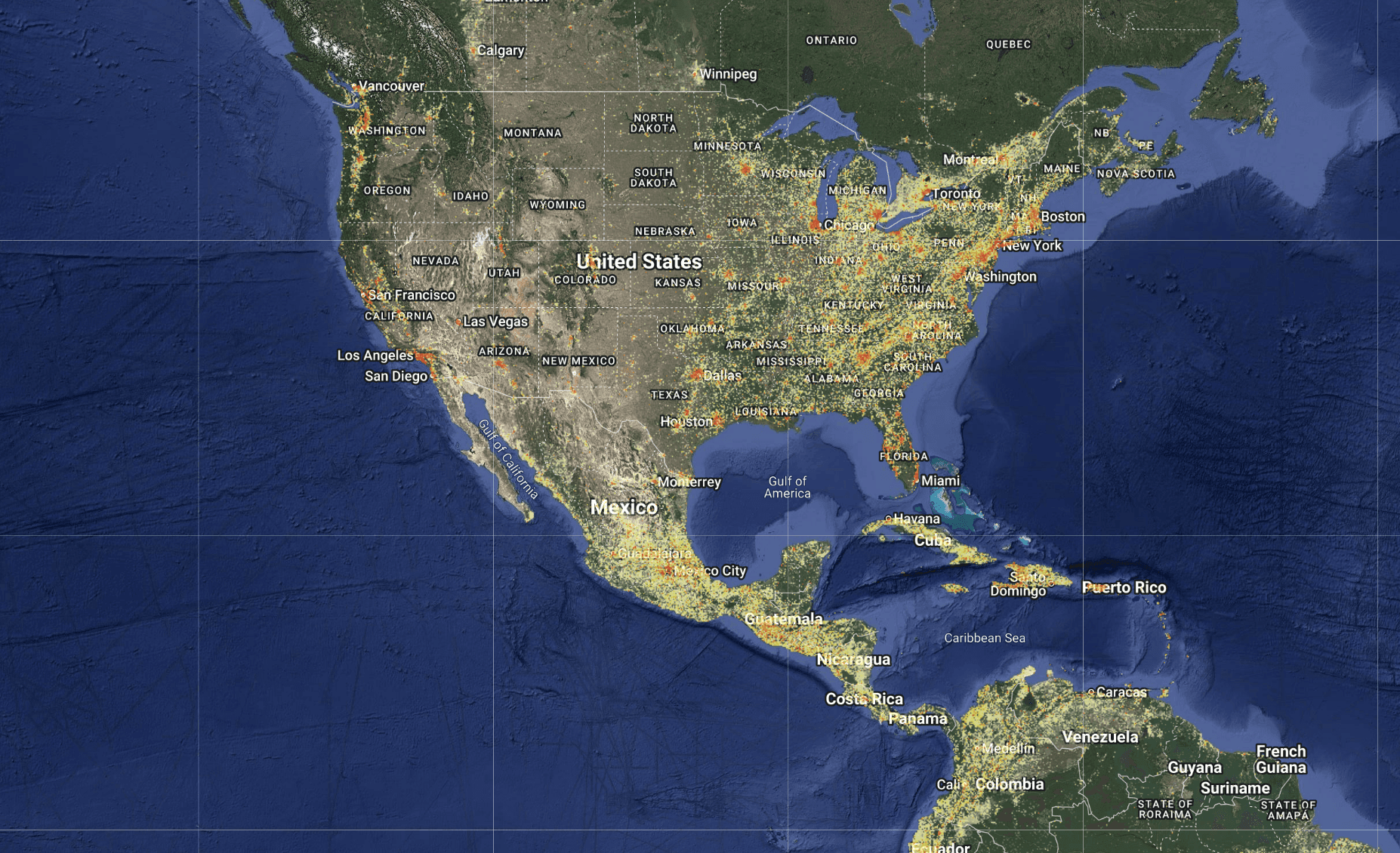
Ambient population measures the distribution and concentration of human activity across a landscape. Instead of focusing only on where residents live, ambient population modeling incorporates commuting patterns, employment centers, transportation networks, tourism activity, commercial districts, universities, and other indicators of daytime presence and movement.
This report analyzes ambient population trends across 55 major U.S. metropolitan areas between 2016 and 2024 using LandScan population data. The goal is not simply to identify which metros gained or lost activity, but to examine how the geography of economic and human concentration has shifted over the last eight years.
The period from 2016 to 2024 included several major structural changes across U.S. metros, notably:
remote and hybrid work adoption
tourism disruption and recovery
changes in commuting behavior
Some metros saw strong increases in ambient population intensity over this period. Others experienced much weaker growth in daytime activity despite continued residential expansion.
What Is Ambient Population?
Residential population datasets estimate where people live. Ambient population attempts to estimate where people are actually present throughout the day.
This distinction matters because human activity is unevenly distributed across metropolitan areas. Employment centers, airports, universities, tourism corridors, industrial zones, entertainment districts, and transportation hubs can all generate large concentrations of daytime activity that are not visible in residential population counts alone.
A metro with moderate residential growth can still experience substantial increases in daytime economic concentration. Likewise, a fast-growing residential metro may see activity disperse across wider suburban areas rather than intensify commercially.
Tourism-heavy metros provide a simple example. Cities such as Las Vegas and Orlando attract large volumes of non-resident activity that significantly influence transportation systems, retail demand, hospitality infrastructure, and daytime density patterns. Residential population alone does not fully capture that economic footprint.
The same principle applies to:
commuter-oriented downtowns
logistics corridors
healthcare clusters
university districts
port activity
airport-driven development
industrial concentration
Ambient population provides an additional lens for understanding how metros function operationally rather than purely residentially.
About the LandScan Dataset
This analysis uses LandScan population data produced through earth-observation and spatial modeling methodologies. Unlike traditional census products, LandScan is designed to model the average spatial distribution of human activity across fine geographic grids.
The modeling process incorporates multiple spatial inputs, including:
land cover and land use
transportation infrastructure
slope and terrain
settlement patterns
road networks
nighttime lights
urban development patterns
census and administrative population inputs
The result is a high-resolution population surface intended to approximate where people are likely to be distributed throughout a 24-hour period.
Because LandScan is designed around ambient human presence rather than purely residential households, it can reveal patterns that differ meaningfully from conventional population rankings.
Ambient Population Growth Rankings (2016–2024)
Metro Area | Landscan 2016 | Landscan 2024 | Ambient 8 yr growth/decline |
|---|---|---|---|
Los Angeles‚ Long Beach‚ Anaheim | 13,343,542 | 12,998,025 | -3% |
Milwaukee‚ Waukesha | 1,618,946 | 1,583,000 | -2% |
Rochester | 1,081,436 | 1,062,976 | -2% |
San Jose‚ Sunnyvale‚ Santa Clara | 2,039,400 | 2,006,405 | -2% |
Memphis | 1,365,544 | 1,346,645 | -1% |
Pittsburgh | 2,467,168 | 2,443,168 | -1% |
Hartford‚ West Hartford‚ East Hartford | 1,184,652 | 1,175,048 | -1% |
San Diego‚ Chula Vista‚ Carlsbad | 3,339,338 | 3,320,037 | -1% |
Cleveland | 2,189,816 | 2,183,762 | 0% |
Buffalo‚ Cheektowaga | 1,169,078 | 1,167,095 | 0% |
San Francisco‚ Oakland‚ Fremont | 4,675,209 | 4,673,752 | 0% |
Chicago‚ Naperville‚ Elgin | 9,439,326 | 9,457,819 | 0% |
St. Louis | 2,820,830 | 2,827,770 | 0% |
Boston‚ Cambridge | 4,950,597 | 5,053,187 | 2% |
New York‚ Newark‚ Jersey City | 19,583,150 | 20,048,772 | 2% |
Baltimore‚ Columbia‚ Towson | 2,796,901 | 2,874,426 | 3% |
Detroit‚ Warren‚ Dearborn | 4,287,244 | 4,424,305 | 3% |
Virginia Beach‚ Chesapeake‚ Norfolk | 1,737,346 | 1,804,041 | 4% |
Birmingham | 1,154,198 | 1,199,125 | 4% |
Louisville/Jefferson County | 1,345,835 | 1,401,859 | 4% |
Philadelphia‚ Camden‚ Wilmington | 6,086,816 | 6,364,843 | 5% |
Minneapolis‚ St. Paul‚ Bloomington | 3,604,013 | 3,778,455 | 5% |
Cincinnati | 2,207,772 | 2,315,272 | 5% |
Salt Lake City‚ Murray | 1,246,820 | 1,307,846 | 5% |
Grand Rapids‚ Wyoming‚ Kentwood | 1,125,312 | 1,185,275 | 5% |
Fresno | 1,131,121 | 1,196,036 | 6% |
Washington DC‚ Arlington‚ Alexandria | 6,104,199 | 6,471,966 | 6% |
Portland‚ Vancouver‚ Hillsboro | 2,404,482 | 2,551,737 | 6% |
Omaha | 947,546 | 1,006,466 | 6% |
Tulsa | 998,164 | 1,065,575 | 7% |
Richmond | 1,286,421 | 1,377,635 | 7% |
Providence‚ Warwick | 1,595,267 | 1,710,135 | 7% |
Denver‚ Aurora‚ Centennial | 2,862,759 | 3,069,122 | 7% |
Columbus | 2,081,565 | 2,237,522 | 7% |
Kansas City | 2,106,984 | 2,265,859 | 8% |
Indianapolis‚ Carmel‚ Greenwood | 2,033,298 | 2,186,674 | 8% |
Sacramento‚ Roseville‚ Folsom | 2,295,938 | 2,476,524 | 8% |
Oklahoma City | 1,386,576 | 1,505,978 | 9% |
Seattle‚ Tacoma‚ Bellevue | 3,826,104 | 4,168,074 | 9% |
Miami‚ Fort Lauderdale‚ West Palm Beach | 5,952,753 | 6,493,956 | 9% |
Tucson | 981,189 | 1,086,032 | 11% |
Riverside‚ San Bernardino‚ Ontario | 4,307,925 | 4,770,273 | 11% |
Atlanta‚ Sandy Springs‚ Roswell | 5,736,438 | 6446379 | 12% |
Las Vegas‚ Henderson‚ North Las Vegas | 2,137,772 | 2,411,808 | 13% |
Phoenix‚ Mesa‚ Chandler | 4,601,830 | 5,215,209 | 13% |
Tampa‚ St. Petersburg‚ Clearwater | 2,999,077 | 3,443,214 | 15% |
Houston‚ Pasadena‚ The Woodlands | 6,812,711 | 7,838,723 | 15% |
Nashville‚ Davidson‚ Franklin | 1,878,412 | 2,162,296 | 15% |
San Antonio‚ New Braunfels | 2,407,211 | 2,778,047 | 15% |
Dallas‚ Fort Worth‚ Arlington | 7,207,930 | 8,389,486 | 16% |
Charlotte‚ Concord‚ Gastonia | 2,484,843 | 2,899,096 | 17% |
Orlando‚ Kissimmee‚ Sanford | 2,460,258 | 2,956,528 | 20% |
Jacksonville | 1,468,967 | 1,770,380 | 21% |
Raleigh‚ Cary | 1,287,205 | 1,570,632 | 22% |
Austin‚ Round Rock‚ San Marcos | 2,038,923 | 2,564,537 | 26% |
Highest Ambient Population Growth Metros
Several Sunbelt metros recorded exceptionally strong ambient population growth between 2016 and 2024.
Dallas, Orlando, Austin, Charlotte, Tampa, and Raleigh all showed large increases in modeled human activity concentration over the study period. Some tourism-oriented metros also maintained unusually strong ambient growth relative to their residential base: Las Vegas and Orlando are two clear examples.
Slower-Growth and Declining Metros
A number of legacy industrial metros experienced weaker ambient population growth over the same period. In several cases, activity growth remained flat despite broader national population expansion.
Some large coastal metros also showed softer ambient growth patterns than expected given their long-term economic importance, Los Angeles being one such example. In certain cases, residential growth continued while ambient concentration weakened or became more spatially diffuse.
The distinction between residential growth and ambient activity is a critical factor in assessing commercial, daytime-oriented prospects for a given geography.
Patterns Emerging Across U.S. Metros
Sunbelt Metros Continued Expanding Operationally
Many of the strongest-performing ambient growth metros were located across the South and Southwest.
Texas, Florida, North Carolina, and Tennessee metros appear repeatedly near the top of the rankings. These regions benefited from continued population inflows, expanding suburban development, logistics investment, and sustained business formation.
In several cases, ambient growth outpaced residential growth expectations, suggesting increasing concentration of commercial and economic activity rather than simple household expansion alone.
Tourism and Entertainment Hubs Maintained Strong Activity Intensity
Tourism-heavy metros remained distinct throughout the dataset.
Las Vegas and Orlando illustrate how visitor economies can sustain high levels of ambient concentration even when residential growth alone does not fully explain commercial intensity. Airports, hospitality corridors, entertainment districts, convention infrastructure, and seasonal travel patterns all contribute to elevated daytime population distribution.
These metros often function differently from traditional residential growth markets because large portions of economic activity are driven by transient populations.
Activity Growth Did Not Always Match Residential Growth
One of the clearest findings from the dataset is that residential population growth and ambient population growth do not always move together.
Some metros with strong projected residential growth showed much softer increases in ambient activity concentration. Others with slower household growth maintained relatively resilient ambient patterns.
Why Ambient Population Matters
Ambient population provides significant insights into human activity over time. While residential population remains an essential measure for long-term demographic analysis, housing demand, and municipal planning, ambient population adds another layer by examining how human activity concentrates across transportation systems, commercial corridors, employment centers, and service areas. These are critical concerns when assessing the potential commercial value of a given territory or trade area, or forecasting the performance of one retail site over another.
Conclusion
Between 2016 and 2024, U.S. metros experienced major changes in how people moved, worked, traveled, and concentrated throughout the day. Ambient population data provides a broader view of those changes by examining the spatial distribution of human activity rather than residential population alone.
The strongest ambient growth metros were not defined solely by household expansion. Tourism intensity, commuting behavior, logistics infrastructure, employment concentration, and commercial development all played important roles in shaping metro activity patterns over the last eight years.
As additional high-resolution population datasets become available, ambient population analysis will likely become increasingly useful for understanding how metropolitan regions evolve beyond traditional residential growth measures.