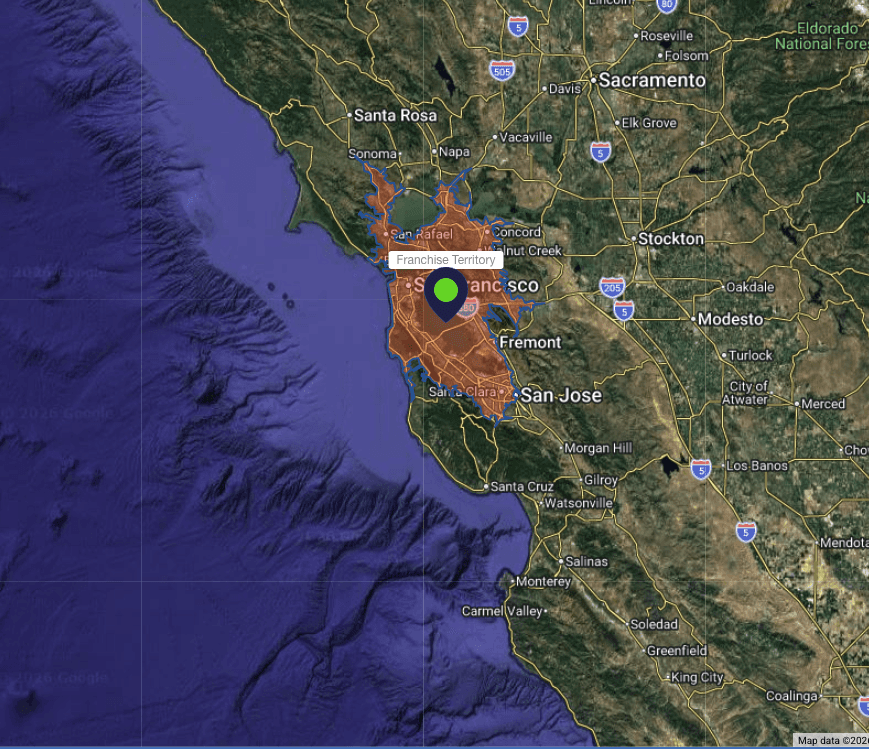
Franchise territory definition is far more complex than simple population counts or radius maps. Learn how franchisors evaluate customer density, economic strength, competitive pressure, accessibility, and market dynamics when designing and valuing franchise territories.
The Wild World of Franchise Territory Definition
As a discipline, franchise territory definition emerged as a reaction to fairly predictable market forces.
Selling one territory across a large geography rarely requires much precision. But as a brand expands - selling more units into tighter, more competitive markets - valuation questions naturally arise. Which markets are stronger? Which territories deserve higher valuations? Which geographies can realistically support additional locations without creating operational or competitive strain?
And as with many disciplines that evolved reactively rather than systematically, methodologies, priorities, and outputs vary widely across franchisors and brands.
One system may rely heavily on population counts. Another may prioritize traffic visibility and customer accessibility. Another may focus on household income thresholds, historical performance, or existing store spacing rules. Internationally, things become even more fragmented. Datasets vary dramatically by country, population reporting standards differ, and some regions have very limited reliable commercial market data available at all.
Franchisors and franchisees both pay dearly for these fractured datasets and inconsistent methodologies. Together, they limit visibility into the relative performance potential of one geography versus another. Which means that, at best, major expansion decisions are being made with incomplete visibility. At worst, territories are being valued and sold based on assumptions that cannot easily be validated. In either case, uncertainty expands drastically.
Further complicating the matter, FDD Item 12s rarely disclose those methodologies in meaningful detail, but the franchisee will still be expected to pay for the territory. Which, in many cases, leaves franchisees (and franchisors) asking obvious questions about the valuation process:
What data was used?
How recent was it?
Were territories built around residential population, daytime population, drive-times, or simple radius distances?
How were competitors considered?
How were future growth trends incorporated?
Were territories designed around customer accessibility, operational efficiency, or simple spacing rules?
In many cases, franchisees and consultants are expected to trust the territory structure without fully understanding how it was developed in the first place.
And the stakes are high.
Why Territory Quality Matters So Much
A franchise territory gives geographic definition to your primary marketplace.
It determines:
which customers you can realistically compete for
how much spending power exists within reach of the business
how far customers must travel to access your product or service
and how much competitive pressure exists between your business and the customer itself
It is difficult to imagine a stronger structural determinant of long-term business performance.
Business schools and expansion strategists have been circling this idea for decades through various playful euphemisms: “selling ice cubes to Eskimos,” “carrying coals to Newcastle,” and other illustrations of dysfunctional trade areas. The underlying message is clearly and widely known: market success is borderline impossible in a fundamentally weak territory. Even exceptional brands will struggle inside territories with insufficient demand, weak accessibility, low spending power, or overwhelming competitive saturation.
Why should this matter to franchisors and franchisees? Because territory commitments are long term: once boundaries are established, and operational expectations are set, changing territory structures can become politically and commercially difficult. That is why sophisticated franchise systems increasingly treat territory definition as a market analysis problem, not just a mapping exercise.
Getting Started, Realistically
Identifying and demarcating a competitive franchise territory requires careful consideration of multiple variables - and often consultation with site-level experts, brokers, consultants, and local operators. One of the most common mistakes in franchise territory planning is assuming there is a single “perfect” solution. There is not.
As we will discuss more below, there are three fundamental market forces that consistently shape territory performance. Miss these, and even otherwise promising markets can struggle. Understand them well, and you can dramatically improve the quality of your expansion decisions. And for these foundational layers of analysis, most franchisors and franchisees can access a wide range of SaaS platforms and commercial datasets capable of supporting meaningful territory evaluation. Many of these tools provide non-technical users access to surprisingly robust analytical workflows.
The goal with these systems is not to become an expert market analyst or advanced GIS technician. It is simply to develop enough visibility into a market to:
validate core assumptions
compare competing geographies
identify obvious weaknesses
and better understand the commercial dynamics shaping a territory’s long-term potential
If you can independently validate basic market fundamentals, you are already operating with more visibility than many franchisees signing off on FDD Item 12 territory structures.
But these toolsets, and the three fundamental market forces, are not the end of the story. Once strong territories have been identified, site-level evaluation becomes the next major layer of focus. And at this stage, most operators will still need support from:
commercial real estate professionals
zoning authorities
brokers
local operators
and, in many cases, physical site visits
There are almost no SaaS platforms or AI systems capable of fully replacing real-world site evaluation. Choosing where exactly to build within a validated, competitive territory requires an assessment of:
visibility
accessibility
surrounding businesses
traffic patterns
customer flow
parking
local aesthetics
and countless other operational realities that rarely appear cleanly in a dataset
Identifying your ideal territory requires first an understanding of your ideal customer. Territory selection is market selection, and your customer is half of that equation. Is your ideal customer young or old, male or female? Working or students? What other types of businesses will they frequent?
Once you’ve got this profile in hand, it’s time to go find these customers. And this is generally a wide-scale, landscaping exercise. The demographic characteristics of two sites located next door to each other will be identical, whereas the demographic characteristics of two territories located 10 miles from each other will be drastically different. And so this part of the exercise is what we could call ‘shrinking the map’ - plotting out demographic ‘pockets’ across the range of territories on offer (or the geographies needing to be subdivided if you’re a franchisor) and comparing the customer density of one to the next. This is also where spatial resolution becomes critical: if your tool system is using census data, many of these demographic pockets will be invisible to you (and that’s because census data comes in huge blocks; it misses more granular trends).
Effective territory evaluation usually combines:
internal operational knowledge
demographic analysis
market research
field validation
commercial datasets
and, in many cases, external consultants or brokers
Some parts of the process can absolutely be handled internally. Others are far more difficult without specialized tools or local market expertise. The goal is not necessarily to become a professional geospatial analyst overnight. The goal is to understand enough about the process that you can ask better questions, validate assumptions and compare markets more intelligently.
This matters because many territory decisions are still built using simplistic proxies:
county populations
static radius distances
outdated census data
or historical spacing rules that no longer reflect how markets actually behave
Modern territory evaluation is usually much more nuanced than that.
The Three Market Forces That Shape Territory Performance
As noted above, territory performance is fundamentally a market analysis exercise.
Your territory defines your geographic marketplace and, as such, it is heavily influenced by three core market forces:
Customer Density
Economic Strength
Competitive Pressure
Understanding these forces does not guarantee success. But misunderstanding them almost guarantees structural weakness.
1. Customer Density
Identifying a strong territory begins with understanding your ideal customer. Territory selection is ultimately market selection, and your customer sits at the center of that process.
Who are they?
Are they:
young or old?
families or students?
commuters or remote workers?
high-income or value-oriented?
residential consumers or daytime workers?
And just as importantly:
where do they physically concentrate?
how do they move?
and which surrounding businesses already capture their attention?
Once this profile is established, the next step is to locate these customers geographically. And this is typically a wide-scale landscaping exercise; the demographic characteristics of two neighboring sites may be nearly identical. But the demographic characteristics of two territories separated by even a few miles can differ dramatically.
This stage of the process is effectively about “shrinking the map.”
The goal is to identify demographic pockets across a larger geography, compare them side-by-side, and progressively narrow toward the strongest potential markets. For franchisors, this may involve evaluating regions that need to be subdivided into future territories. For franchisees, it may involve comparing multiple candidate markets against one another before committing capital.
And this is where spatial resolution becomes critically important. Not all demographic systems observe markets with the same level of precision. Many older territory mapping applications still rely heavily on census-based datasets aggregated into relatively large geographic blocks. While useful at broad scales, these systems can miss smaller pockets of density, emerging growth corridors, or rapidly changing commercial areas that become critically important during territory evaluation. Higher-resolution population systems can often reveal patterns that remain invisible inside broader census aggregation models - particularly in fast-growing suburban corridors, mixed-use urban environments, and internationally fragmented markets.
2. Economic Strength
Customer density alone does not create a viable territory. A territory packed with people can still fail commercially if those customers lack the spending power, purchasing behavior, or commercial demand necessary to support the offering. Conversely, relatively small territories with strong economic fundamentals can significantly outperform much larger geographies.
This is where economic strength enters the equation. And much like customer density, economic strength is rarely distributed evenly across a market.
Two territories located minutes apart can exhibit completely different economic realities. One may contain rapidly growing commercial corridors, high-income residential communities and dense daytime employment centers. Another may contain stagnant retail activity, weaker purchasing power and declining commercial investment. The challenge for franchisors and franchisees is that these differences are not always visually obvious.
Busy roads can create the illusion of economic vitality. New housing developments can create the illusion of sustained long-term growth. Even high population density can create a false sense of market strength if household purchasing power is weak or commercial activity is already overextended. And so the goal is not simply to identify where people live. It is to identify where economically viable customers are concentrated.
Depending on the franchise model, this may involve evaluating:
household income
disposable income
daytime population density
business activity
commercial growth
consumer spending patterns
or broader indicators of economic stability
A premium fitness franchise, for example, may require entirely different economic conditions than a discount-oriented home services offering. A B2B service franchise may care far more about business concentration and commercial activity than residential income levels.
The more visibility you have into the economic structure of a territory, the easier it becomes to compare one geography against another and identify whether a market’s apparent strength is supported by genuine commercial fundamentals — or simply surface-level activity.
3. Competitive Pressure
The final major force shaping territory performance is competitive pressure. A territory containing very few competitors may indicate a strong whitespace opportunity. Or it may indicate weak underlying demand. Conversely, heavily saturated commercial corridors may signal intense competition, or extremely strong customer concentration.
A territory may appear strong on paper because it contains:
high population density
strong income levels
visible retail activity
But if every major commercial corridor is already heavily saturated with direct or substitute competitors, the actual opportunity may be far weaker than initial impressions suggest.
And competitive pressure does not only come from direct competitors.
Depending on the franchise model, pressure may also emerge from:
substitute businesses
internal brand cannibalization
shifting retail corridors
changing consumer mobility patterns
or adjacent concepts competing for the same customer attention
This is particularly important in mature franchise systems where expansion itself can begin creating internal overlap between territories.
And much like customer density and economic strength, competitive pressure is rarely distributed evenly across a geography. One side of a territory may contain highly concentrated commercial corridors while another remains comparatively underserved.
Why Inbound and Outbound Franchise Models Behave Differently
Inbound and outbound franchise models obey very different geographic constraints.A territory that performs exceptionally well for one franchise model may be fundamentally broken for another, even when both are operating within the exact same geography.
This is because the mechanics of customer acquisition are different. Some businesses require customers to travel toward the business - inbound. Others require the business to travel toward the customer - outbound. And, primarily because customers almost always prioritize convenience when given two equal options, this makes ‘population within reach’ a fundamental driver for inbound territory evaluation; less so for outbound.
Inbound Franchise Models
Inbound businesses depend on customers physically traveling to the business location.
Examples include:
restaurants
fitness centers
coffee shops
medical clinics
retail stores
and most consumer-facing franchise concepts
In these models, convenience becomes a dominant market force in selecting a retail site. Customers overwhelmingly gravitate toward the options that are easier to access, faster to reach or more visible. And this is why territory evaluation cannot stop at simple population counts, especially for inbound models.
A territory may contain a large population dispersed over a wide geographic area, while still performing poorly because customers are separated by:
congestion
weak transportation infrastructure
inconvenient traffic flows
physical barriers
or simply inefficient travel patterns
Similarly, geographic distance is a misleading indicator for inbound franchise models. A one-mile radius may represent a 5-minute travel commitment in some suburbs, whereas in others it may require an hour.
To account for this ‘convenience factor’, inbound territories must assess travel-time trade areas (isochrones) to measure the reachable customer base.
Outbound Franchise Models
Outbound businesses operate under a very different set of geographic constraints. In these systems, the business travels to the customer.
Examples include:
HVAC
roofing
pest control
commercial cleaning
mobile repair
home services
and many B2B service concepts
Customer convenience still matters. But accessibility behaves differently because the customer is no longer responsible for the majority of the travel burden. Operational efficiency becomes the dominant constraint instead.
Which means territory evaluation increasingly shifts toward:
technician routing
service density
travel time per visit
labor distribution
transportation costs
scheduling efficiency
and operational scalability
This distinction matters because a territory with strong raw population counts can still become operationally inefficient if customers are geographically dispersed. Under these conditions, the ‘visits-per-hour’ metric could suffer. On a similar note, hyper-dense geographies which might suffer from traffic congestion or other delaying factors, would also be unattractive: anything which could reduce the amount of sales calls or service visits technicians can reasonably serve should be avoided.
How Much Can You Reasonably Validate Yourself?
Not every franchise operator needs a dedicated analytics team to pick a high performance territory. Most operators can validate far more than they realize, and for a fraction of the cost one might face with an underperforming location.
Over the past decade, territory analysis tooling has become dramatically more accessible. Tasks that once required GIS specialists, consultants or expensive demographic reports can now often be performed through relatively approachable SaaS platforms and commercial datasets.
Today, franchisors, consultants and franchisees can independently evaluate a surprisingly wide range of market characteristics, including:
daytime population
mobility-adjusted accessibility
business density
commercial growth patterns
and territory comparison workflows
This provides a significant strategic advantage: a franchisee who can independently compare territories, validate customer concentration and evaluate competitive saturation is operating with substantially more visibility - and thus risk management capabilities - than someone relying entirely on high-level summaries or fixed geographic boundaries.
At the same time, it is important to understand that not all datasets, or territory analysis systems, are built equally. Some platforms still rely heavily on static census products aggregated into large geographic units. Others incorporate modeled population systems, higher-resolution demographic surfaces, mobility-aware trade areas or commercial business databases. Internationally, the differences become even more pronounced, as market standardization varies dramatically from country to country.
These differences matter. Two territory evaluation systems using different population models, trade-area methodologies or business datasets can produce meaningfully different interpretations of the exact same geography. Which means understanding the limitations of the underlying data is just as important as understanding the outputs themselves.
For example:
a census-based system may miss smaller growth corridors or rapidly changing suburban development
incomplete business databases may underestimate competitive pressure
and residential population alone may fail to capture daytime commercial demand
This does not mean modern self-service analysis lacks value. Quite the opposite. With a basic understanding of the underlying datasets, their strengths and weaknesses, franchisors and franchisees can independently validate the core market fundamentals shaping territory performance long before committing capital.
It bears repeating, however, that software alone will not complete the picture. Some decisions, specifically the more granular site build-out decisions, continue to require:
physical site visits
local operational knowledge
commercial real estate expertise
brokers
zoning review
field validation
and experienced market judgment
Understanding the Data Behind Territory Decisions
One of the biggest differences between territory methodologies is the quality and type of underlying datasets being used.
Some systems still rely heavily on static census products. Others increasingly incorporate:
high-resolution population models
mobility-adjusted trade areas
commercial POI datasets
satellite-derived population estimates
and forecast models
This matters because different datasets can produce very different conclusions.
For example:
residential population alone may miss daytime demand - very few people shop, eat and run errands right outside their homes.
outdated census products may miss migration trends - in general, census data are captured once every decade.
and incomplete business datasets may underestimate competitive pressure
Every dataset has its weaknesses and strengths. The goal of territory selection is not to find the perfect dataset, but make informed decisions about territory prospects.
Reducing Risk Through Better Territory Validation
Effective territory selection rarely relies on a single metric, dataset or territory map.
Instead, it combines:
demographic analysis
economic evaluation
competitive research
accessibility modeling
field validation
operational realities
and ongoing iteration
to progressively reduce uncertainty.
No dataset, consultant or SaaS platform can fully eliminate market risk. Consumer behavior changes. Commercial corridors evolve. Competitors emerge. Transportation patterns shift. Entire neighborhoods can strengthen or decline within just a few years. A territory that appears highly attractive today may behave very differently tomorrow.
Any franchisor or franchisee entering a new market should be prepared for that uncertainty. But that uncertainty does not render us powerless: we can still make informed decisions today that reduce the likelihood of obvious and near-certain failures tomorrow.
Franchisors and franchisees who understand the strengths and limitations of their underlying territory methodologies are simply operating with better visibility than those relying entirely on intuition, static boundaries or unvalidated assumptions. And today’s territory analysis toolsets make that visibility more accessible - and more affordable - than ever before.
→ Explore Franchise Territory Analysis
Explore expert articles, eCommerce guides, and the latest updates to help your business grow smarter and sell better with Unistore.
May 6, 2026
How Franchisors Evaluate and Define Franchise Territories
Franchise territory definition is far more complex than simple population counts or radius maps. Learn how franchisors evaluate customer density, economic strength, competitive pressure, accessibility, and market dynamics when designing and valuing franchise territories.
May 4, 2026
Mexico City Retail: Demand Is Outpacing Supply
Retail in Mexico City reaches most of the population but demand is outpacing supply. See where existing corridors are underbuilt and where expansion opportunities exist.
Apr 30, 2026
The 3 Factors That Determine Franchise Territory Performance
Franchise territories are often evaluated by size or population, but performance is driven by three core factors: customer base, competition, and economic strength. This article outlines how franchisors use these factors to design, compare, and price territories with greater precision.