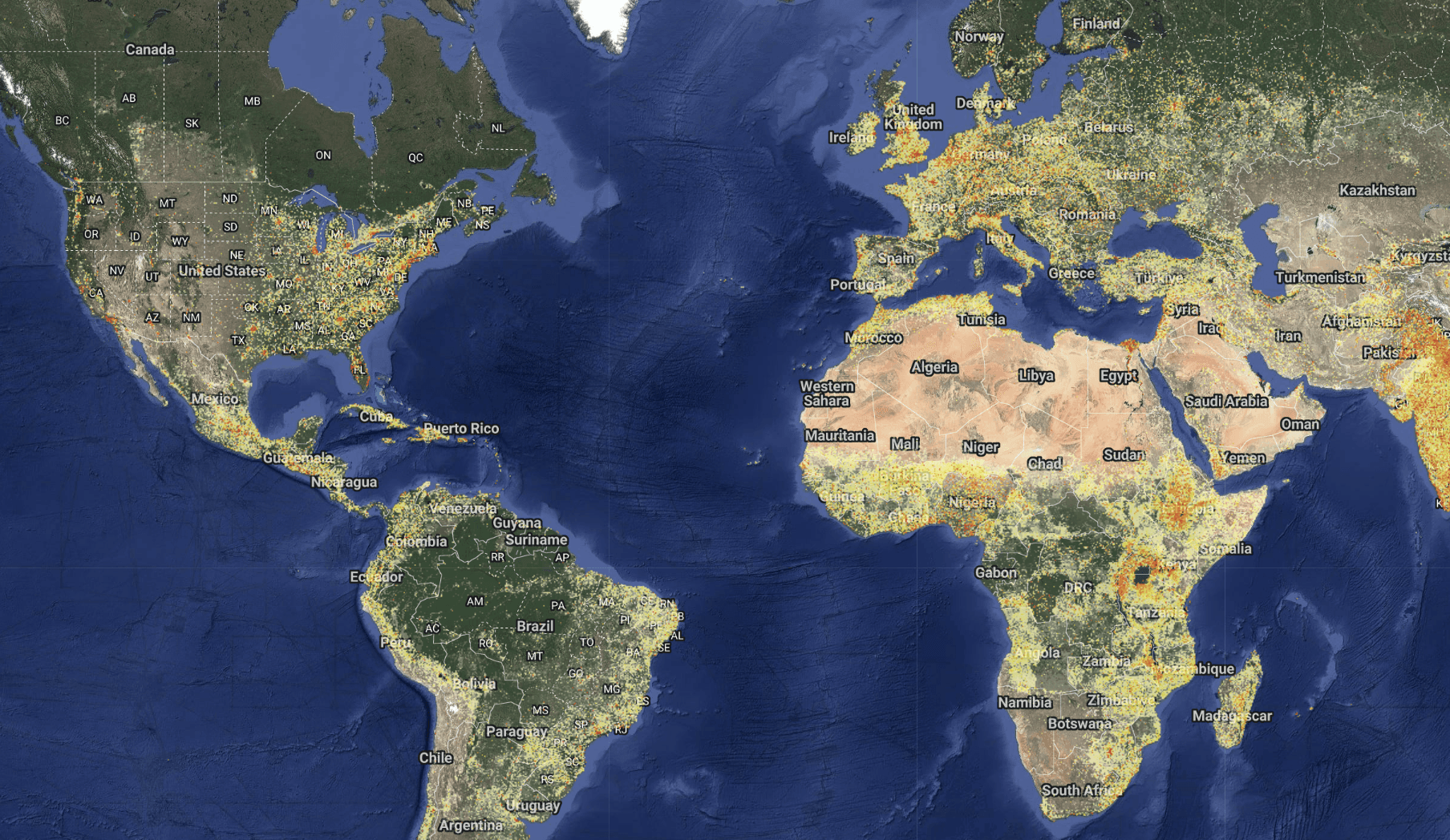
Designing territories across a city, region, or country often means you need a stable, comparable baseline year to year.

Overview
LandScan is a widely used global gridded population dataset developed by Oak Ridge National Laboratory (ORNL). It models an ambient population—an estimate of where people are present throughout the day (daytime + nighttime)—disaggregated from census or administrative-level totals into fine spatial grids. LandScan is often used in risk, planning, emergency response, and infrastructure analyses because it offers consistent annual updates and spatial detail beyond coarse census units.
Methodology & Spatial Characteristics
Base resolution: ~30 arc-seconds (~1 km) globally.
Dasymetric weighting: Allocates census totals to cells using roads, land cover, slope, night-time lights, and other covariates.
Normalization: Grid sums match census or projection totals.
Ambient model: Reflects daily presence, not just residence.
LandScan HD: In select regions, ~3 arc-seconds (~90 m) grids for day/night distributions.
Strengths & Use Cases
Consistency: Annual, globally consistent updates support year-to-year comparability.
Ambient insight: Useful for risk, commuting, service, and infrastructure analyses.
Global coverage: Fills data gaps where censuses are sparse.
Limitations & Caveats
Resolution ceiling: Smoothing at ~1 km; neighborhood-level variation lost.
Model assumptions: Proxy weights may misallocate population in atypical settings.
Temporal lag: Census inputs may be outdated.
Ambient mismatch: Not directly comparable to residential-only counts.
Related Resources
Need More Help?
If you run into issues, please contact us.
Explore expert articles, eCommerce guides, and the latest updates to help your business grow smarter and sell better with Unistore.

May 14, 2026
São Paulo Retail and Franchising: Emerging Retail Corridors Beyond the City’s Established Commercial Centers
São Paulo’s strongest retail opportunities may not emerge from its most established commercial centers. Using high-resolution population forecasts, ambient population analysis, retail density, and drive-time territory mapping, this analysis explores how customer growth and retail competition are beginning to diverge across several secondary corridors in the broader São Paulo metro.

May 12, 2026
55 U.S. Metros Ranked by Ambient Population Growth (2016–2024)
Ambient population measures where people actually concentrate throughout the day across work, commuting, tourism, logistics, and commercial activity. This report analyzes ambient population growth trends across 55 major U.S. metros between 2016 and 2024 using LandScan data, revealing how patterns of human activity have shifted beyond residential population growth alone.

May 11, 2026
Site Selection Analysis: Is Cape Town’s New R650m Mall in the Right Location?
Cape Town’s new R650 million GrandWest Mall development sits less than 10km from Canal Walk, one of Africa’s largest shopping malls. At first glance, the location appears risky. But drive-time catchment analysis tells a very different story. This analysis explores how primary, secondary, and tertiary retail trade areas shape competition, customer accessibility, and mall performance, and why geographic distance alone can be misleading in retail site selection.