Overview
Census data represent one of the foundational pillars of demographic analysis — offering officially collected population counts, household characteristics, age/sex breakdowns, and socio-economic attributes at administrative units (e.g. blocks, tracts, municipalities). Governments conduct censuses periodically (often every 5–10 years) to “count everyone,” and these enumerated totals form the gold standard reference for many planning, funding, and policy processes.
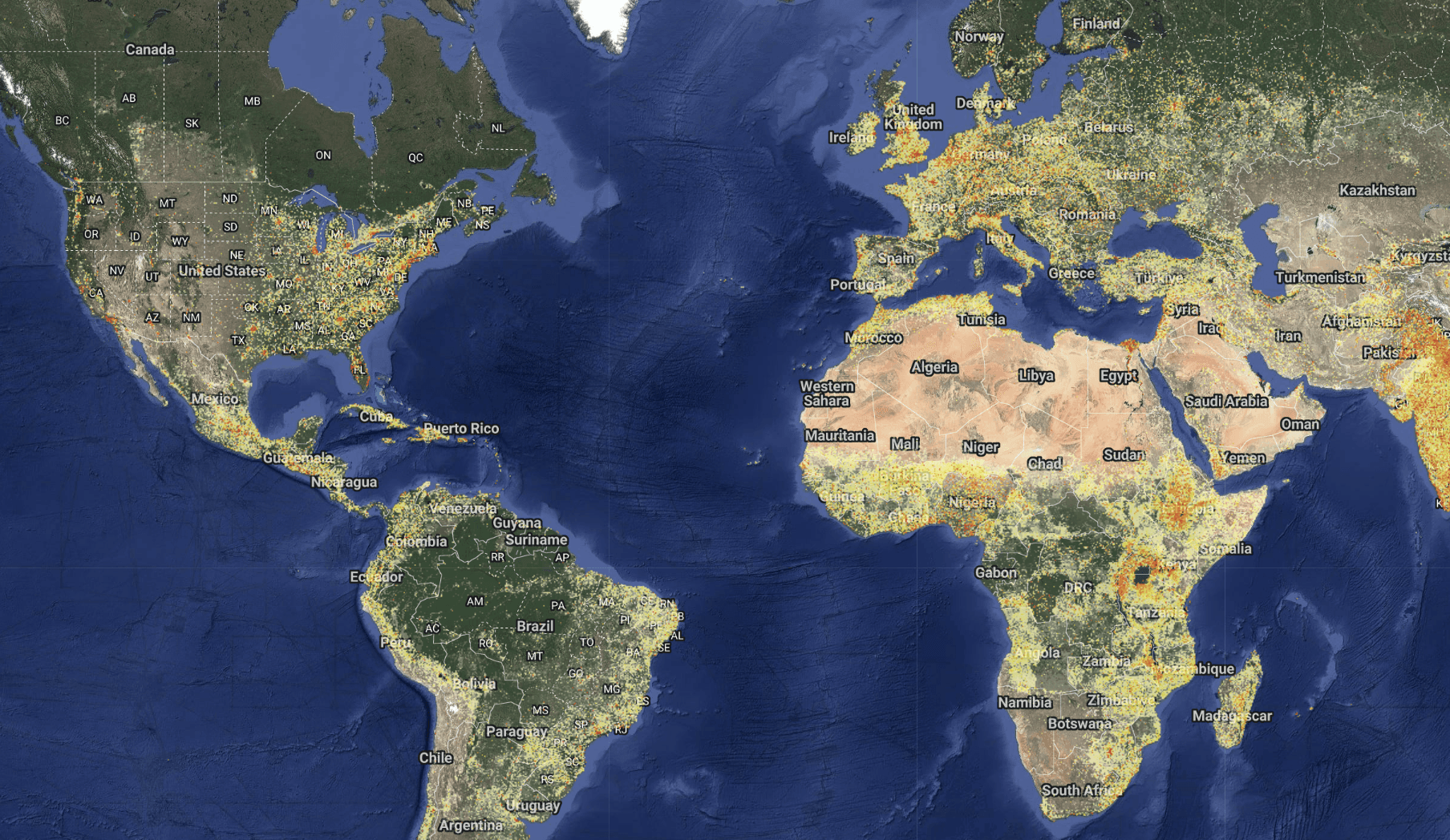
However, censuses also have limitations: they’re static snapshots based on place-of-residence definitions, subject to undercount or nonresponse bias, and often aggregated to coarse geographies. In fast-growing or informal regions, the census may lag behind real conditions. That’s where gridded population models (like LandScan, WorldPop) step into the gap — disaggregating census counts into finer spatial units using ancillary data (satellite imagery, land use, building footprints) to create continuously modeled surfaces.
In PopEx, we rely primarily on gridded models for flexibility, consistency, and fine granularity — but census data remain critical as the ground truth anchor and calibration baseline. This article explains how census and gridded models differ, when to rely on each, and how that affects your analytic workflows in clusters like site selection, telecom, and humanitarian planning.
Key Differences: Census vs Gridded Models
Feature | Census Data | Gridded Population Models |
|---|---|---|
Spatial Units | Aggregated to administrative units (e.g. census tracts, blocks) | Continuous grid cells (e.g. 100 m) via disaggregation |
Temporal Frequency | Periodic (5–10 years, sometimes with intercensal estimates) | Annual or more frequent projections (e.g. WorldPop 2015–2030) |
Attribute Depth | Rich attributes (income, education, household size) | Limited; attributes inferred from census-level data and covariates |
Boundary Dependence | Counts locked to official boundaries | Flexible to any shape (buffer, isochrone, custom polygon) |
Bias & Accuracy | Subject to enumeration error and timing lag | Dependent on model assumptions and covariate quality |
Use Cases | Policy, resource allocation, legal frameworks | Spatial modeling, scenario analysis, fine-scale decision support |
Implications for PopEx Workflows
When Census (Administrative) Data Is Preferable
Legal or funding contexts: when results must align with official boundaries.
Stable regions: where population change is minimal between censuses.
Attribute-rich analysis: when socio-economic details like income or education are critical.
Model calibration: to benchmark or constrain gridded model predictions.
When Gridded Models Are Superior
Fine spatial resolution: for evaluating within-boundary variation (e.g. along corridors or city centers).
Custom geographies: buffers, isochrones, or service areas that cross admin boundaries.
Rapidly changing areas: informal settlements or peri-urban zones.
Cross-country comparison: enabling consistent metrics across regions.
Caveats & Best Practices
Always verify metadata, dataset year, and original census vintage.
In outdated census regions, cross-check gridded models with local data or surveys.
Document assumptions and note uncertainty when mixing census and modeled data.
Triangulate multiple datasets where possible to improve reliability.
Next Steps
Need More Help?
If you run into issues, please contact us.