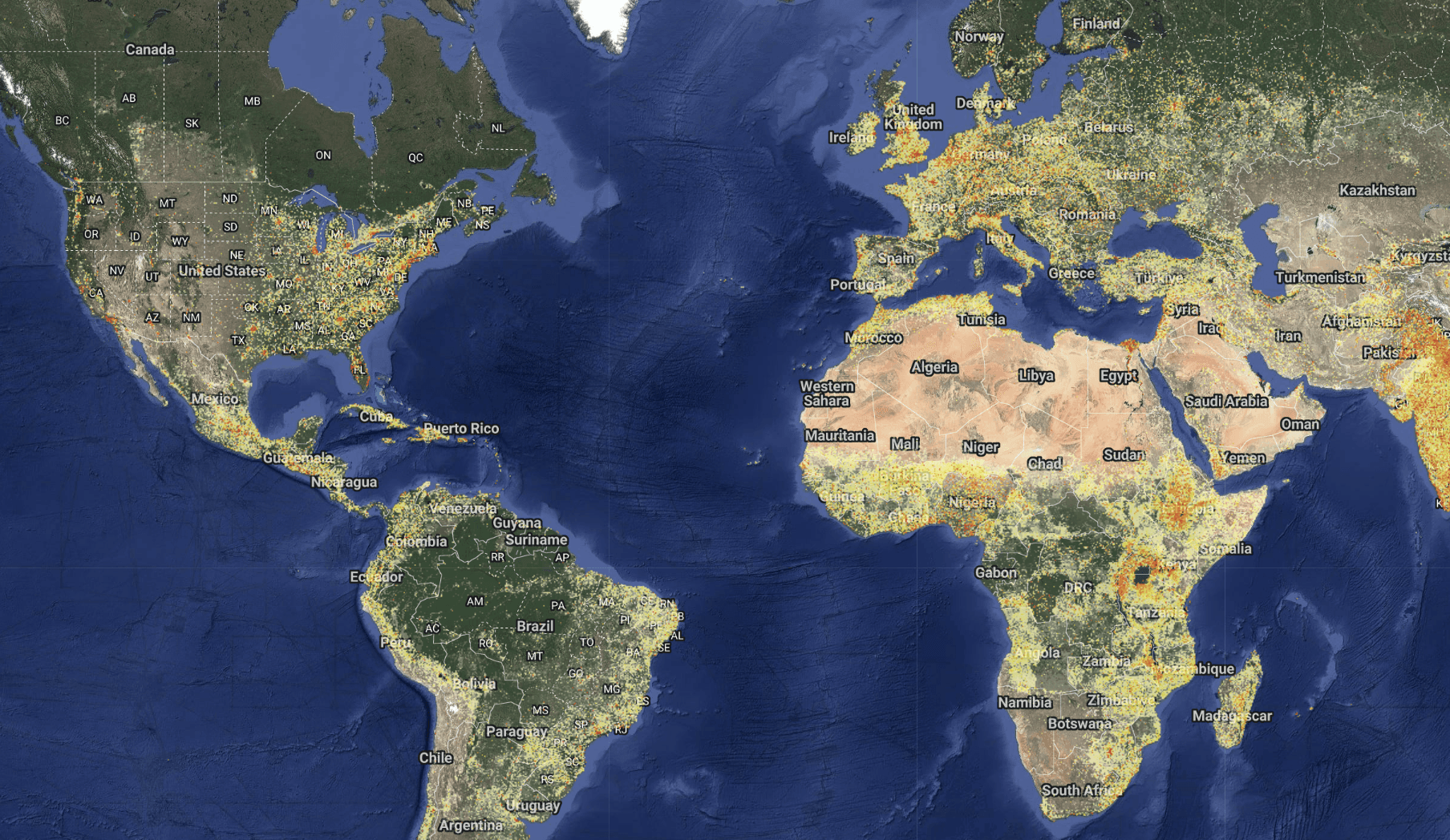
When you’re carving neighborhood‑scale territories, you need data that follows settlement patterns closely.

Overview
WorldPop is a global population mapping initiative that produces high-resolution, gridded estimates. The constrained top-down approach disaggregates census totals to ~100 m grids but only within cells mapped as settlements or buildings. This improves alignment with where people actually live.
Methodology & Spatial Characteristics
Settlement mask: Allocation restricted to cells with mapped buildings/built areas.
Machine learning: Random Forest models use census + covariates (satellite, land cover, infrastructure).
Resolution: ~3 arc-seconds (~100 m).
Normalization: Totals aligned to census aggregates.
Strengths & Use Cases
Settlement alignment: Maps residential distribution accurately.
Higher resolution: Finer than LandScan’s ~1 km.
Reduced misallocation: Prevents population in empty zones.
Limitations & Caveats
Settlement detection: Missing or misclassified dwellings lead to underestimates.
Input census quality: Errors propagate.
Comparability: Diverges from ambient-use datasets like LandScan.
Related Resources
Need More Help?
If you run into issues, please contact us.
Explore our latest thinking on franchise territory design, retail site selection, and the population data that powers smarter location decisions.

Aug 7, 2026
Daytime Differential: What It Is, and Why Your Retail Site Selection Strategy Needs It
What is Daytime Differential? The ratio of ambient to residential population for a site, and why site selection needs both types of data to make informed decisions.

Aug 7, 2026
Daytime Population of Europe's Million-Plus Cities, Ranked (2026)
Daytime vs. residential population, ranked across Europe's 43 million-plus cities. Some nearly double during the day; others barely hold half.

Jul 27, 2026
UK Postcode Districts Ranked by Ambient Population: Growth Leaders and Decliners (2016–2024)
This report ranks UK postcode districts by ambient population using LandScan data covering 2016 to 2024. Ambient population measures where people actually concentrate throughout the day, across employment, commuting, retail, logistics, and commercial activity, rather than simply where they sleep at night.