Most retail location decisions don’t fail because of bad strategy - they fail because of bad data.
Retail and franchise site selection decisions must factor trade-area population in order to succeed (read this article on the three factors that determine retail site selection success).
If you don't have sufficient quantities of potential buyers, you won't have sales. But equally, if you’re using the wrong population dataset, you’re not finding customer hotspots - you’re guessing.
In practice, it can be very difficult to measure population in a trade-area.
Physically counting every single person would be unrealistic, so instead, site selection decisions rely on modeled population data - and small differences in how that data is built can completely change which locations look “high potential.”
Two sites can appear identical on paper, but perform completely differently in reality. And the difference often comes down to the dataset.
So which population data actually reflects real demand?
Why population data is harder than it looks
Before comparing datasets, it’s important to understand the underlying problem. Population isn’t static, and it isn’t evenly distributed.
People don’t stay at home all day
Commercial corridors attract daytime populations far beyond residential counts
Administrative boundaries (like census tracts or postal codes) rarely match how people actually move
Resolution matters - coarse data hides meaningful differences between locations
And different datasets capture these dimensions differently.
Some are designed to measure where people live at a very high-level (for example, calling out the number of residents across an entire zip-code).
Others attempt to estimate where people live at a very granular level (for example, calling out the number of residents in a 100m area).
And a few are built to reflect where people are actually present and active throughout the day.
Those differences may seem subtle, but they can completely change how a location or territory looks on a map.
And that distinction is critical for:
Trade area analysis
With that in mind, let’s look at the three most commonly used datasets.
Census Data: Authoritative, but often misleading for site selection
What it is
Census data is the most widely used population dataset. It’s collected directly by governments and reported at administrative levels like tracts, blocks, and counties.
Strengths
Official and highly trusted
Consistent across regions
Useful for macro-level analysis (market sizing, demographics)
Weaknesses
Updated infrequently (often years behind reality)
Aggregated into fixed boundaries that don’t reflect real trade areas
Lacks the spatial precision needed for site-level decisions
Census data can tell you:
“This area has 50,000 residents”
But it can’t tell you:
How those people are distributed within the area
Where density actually concentrates
How many people pass through during the day
Role in site selection
Census data is useful for high-level planning, but unreliable for choosing specific locations or designing balanced territories.
It’s a starting point - not a decision-making tool.
WorldPop: Higher resolution, residential focus
What it is
WorldPop is a modeled population dataset that uses satellite imagery, land use data, and machine learning to estimate where people are distributed at a much finer resolution.
Strengths
Much more granular than census data
Better representation of spatial distribution
More frequently updated
Weaknesses
A modeled estimate (not observed activity)
Can smooth over real-world variations
Focuses primarily on residential population patterns
WorldPop improves on census by answering:
“Where are people likely to live within this area?”
But it still struggles with:
Daytime population shifts
Commercial activity zones
Real-world movement patterns
Role in site selection
WorldPop is a significant improvement over census, especially for understanding spatial density of residents within a trade area. Where census is too coarse, WorldPop provides granularity.
LandScan: Built around how people actually move and spend time
What it is
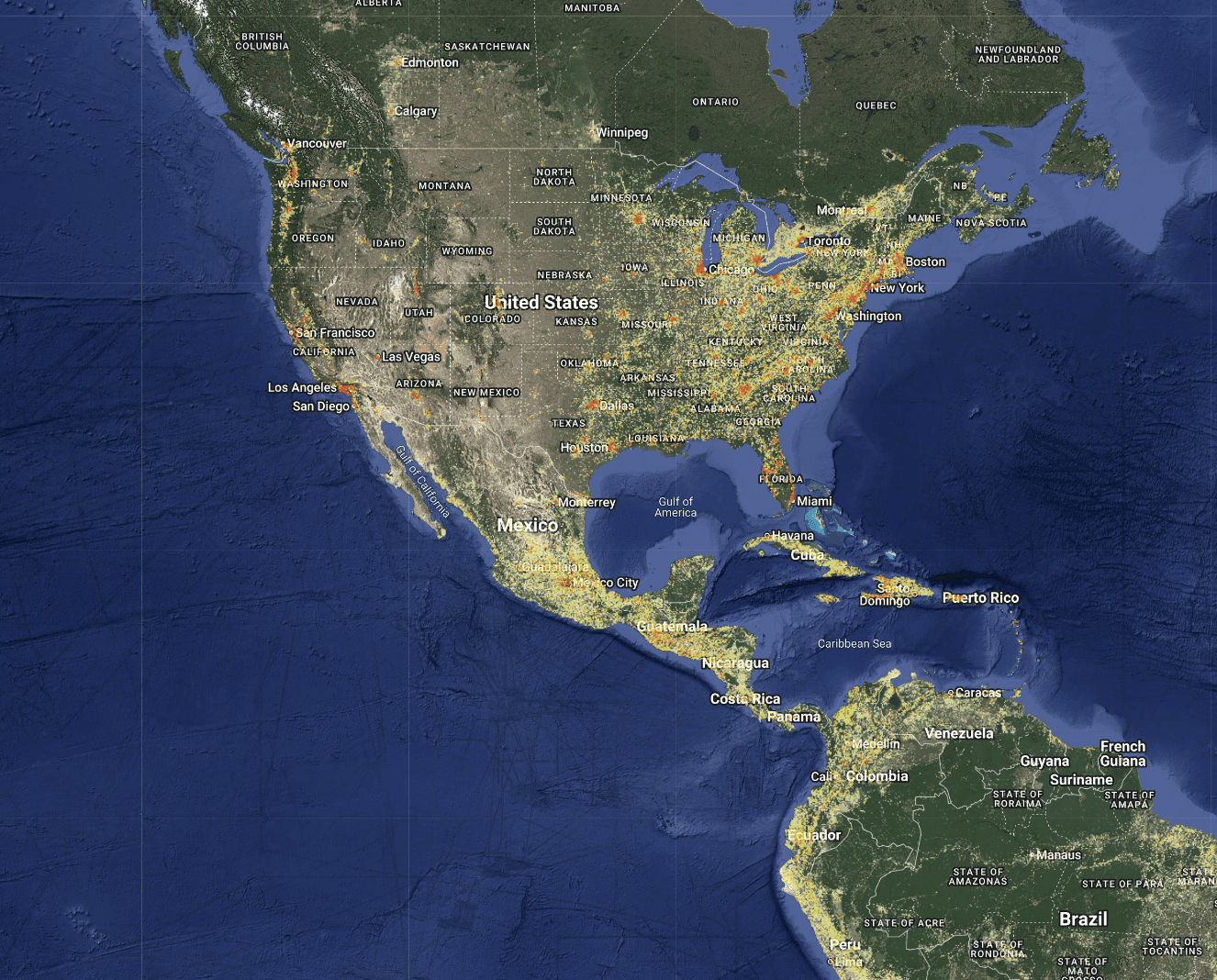
LandScan is an ambient population dataset designed to estimate where people are present over a 24-hour period—not just where they live.
Strengths
Reflects daytime and nighttime population distribution
Captures real-world activity patterns (work, travel, commerce)
High spatial resolution
Updated regularly
This means LandScan answers a fundamentally different question:
“Where are people actually present and active?”
For retail and franchise decisions, that distinction is critical: a location with modest residential population but high daytime traffic may outperform a strong residential area.
Weaknesses
Less familiar to many business users
Requires tools that can properly analyze and visualize the data
Verdict for site selection
LandScan is a complementary dataset to Census and WorldPop, in that it aligns with real human activity, not just residential counts. Measuring territories based on ambient population will give a better read on what traffic to expect during commercial hours (as an example, you can review our ranking of US Zip Codes based on ambient population).
What this means for retail site selection and franchise territories
The dataset you choose directly shapes your decisions.
Using coarse or outdated data can lead to:
Overestimating demand in low-activity areas
Missing high-opportunity locations
Creating unbalanced or underperforming territories
For example:
Two territories may have identical census populations
But one has far higher daytime density and commercial activity
Only one of them is likely to succeed.
The same applies to site selection:
A location may look strong based on residential counts
But underperform due to lack of real-world traffic
Want to see how different datasets change a location?
Try mapping a real trade area and compare population density in seconds.
→ Map a Location
Site selection is a funnel—not a single data point
The best site selection strategies don’t rely on a single dataset.
They follow a progression:
Start broad
Use census or high-level data to understand the overall marketRefine with higher resolution
Identify where population density actually concentratesValidate with real-world activity
Focus on where people are present, moving, and interacting with businesses
The closer your data reflects real human behavior, the more confident your decisions become.
The bottom line
Most retailers and franchisors aren’t making bad strategies - they’re making decisions with incomplete data. And when you’re choosing locations or defining territories, small differences in data quality can lead to dramatically different outcomes.
Next up: