Why Retail Site Selection Matters
For inbound sales traffic - which is the predominant transaction type for brick-and-mortar retail offerings - location defines your market: how many people will reasonably 'see' your offerings, and how many potential sales you can expect to get.
A great product in the wrong location will almost always struggle. An average product in the right location often outperforms expectations.
To win in today's marketplace, retail brands must bring as much rigor and research to the process of selecting an optimal retail site as they do to their product development.
Retail Site Selection Fundamentals
Selecting optimal retail sites often involves evaluating complex, constantly changing data. Faced with this daunting task, many business owners outsource the process entirely to external consultants: realtors, market research professionals and more. This is expensive, and doesn’t always lead to better outcomes.
The best retail locations consistently score high across three fundamentals. Get these correct and you will have more confidence, lower risk and much less to discuss with external 'experts'.
Analyze Population Trends Within Your Trade Area
Start by understanding the people you’re trying to reach.
Focus on:
The goal is to answer: Does this area contain enough of the right customers to support your business? The lower the population count in your trade area, the lower your potential sales (e-commerce industries present some exceptions here). And pay close attention to age/sex breakdowns: your product likely resounds with a few specific bands (18-24 year-old females, for example) and so you will want more detail than simply raw population counts in order to make your decisions.
Evaluate Competitors and Allies Within Your Trade Area
Next, evaluate the competitive landscape.
Search through Google POIs and save on your map:
Direct competitors
Complementary businesses (“allies”)
Overall retail density
This helps you determine: Is this an underserved opportunity — or an oversaturated market? Competitor density predicts just how hard you may have to fight for customers, although the presence of competitors is not always a negative factor: more competitors means the marketplace is educated in your product type, and provides options for differentiation. Allies are complementary, adjacent industries that attract similar customer profiles. Think health-food industries and fitness centers: a fitness center franchisee would do well to consider trade areas with high numbers of health food retailers.
Define Trade Areas Using Travel Time, Not Distance
Understanding where your customers come from is critical — but how you define that area matters just as much.
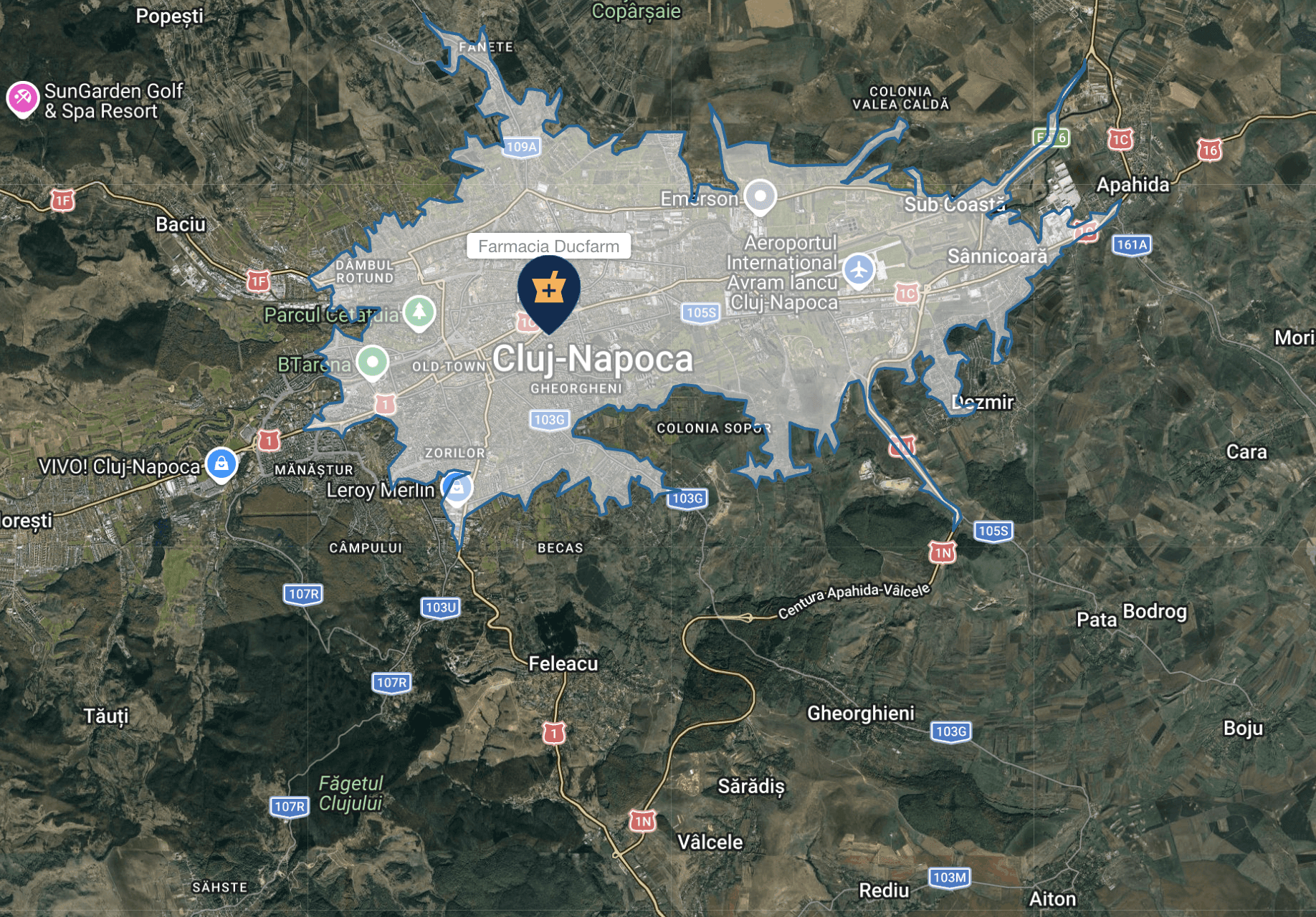
The most effective way to define a trade area is by using travel-time polygons (also known as isochrones), rather than simple radius distances.
Why?
Because travel time directly influences purchasing behavior. If a customer can get the same product by traveling for 10 minutes instead of 45, they will almost always choose the closer option.
Distance alone doesn’t capture:
road networks
traffic patterns
real-world accessibility
Travel-time analysis does.
When Travel Time Matters Most
This approach is especially important for:
Retail locations
Restaurants and quick-service brands
Brick-and-mortar consumer businesses
In these cases, convenience is often the deciding factor.
When It Matters Less
There are exceptions.
For example:
Service-based franchises
Businesses with outbound sales models
In these cases, the business goes to the customer — so travel time plays a different role.
Putting it Into Practice: How to Analyze Candidate Retail Sites
While the framework above is straightforward, executing it in practice can quickly become complex.
To properly evaluate a single location, you need to:
Map competitors and nearby businesses
Doing this manually often means juggling:
spreadsheets
static maps
disconnected data sources
This process is not only time-consuming — it also makes it difficult to confidently compare locations or spot meaningful differences.
Accurate Data, User-Friendly Tools
Modern retail teams are increasingly shifting toward tools that bring all of this analysis into a single workflow.
With the right retail site selection software, you can:
Instantly define trade areas using travel-time polygons
Analyze population, income, and demographics in seconds
Visualize competitors and surrounding businesses
Compare multiple locations side-by-side
Instead of stitching together multiple tools and datasets, you get a clear, consistent view of each opportunity.
Make Better Retail Decisions with Retail Site Selection Software
If you’re evaluating where to open your next location, using the right tools can dramatically improve both speed and accuracy.
Explore how retail site selection software can help you analyze locations, define trade areas, and make more confident decisions.
Need Help Getting Started?
If you’re new to trade area analysis or location evaluation, we’ve put together step-by-step guides in our knowledge base covering:
How to compare multiple locations
Browse the retail site selection hub to learn more about best practices and other use-cases.