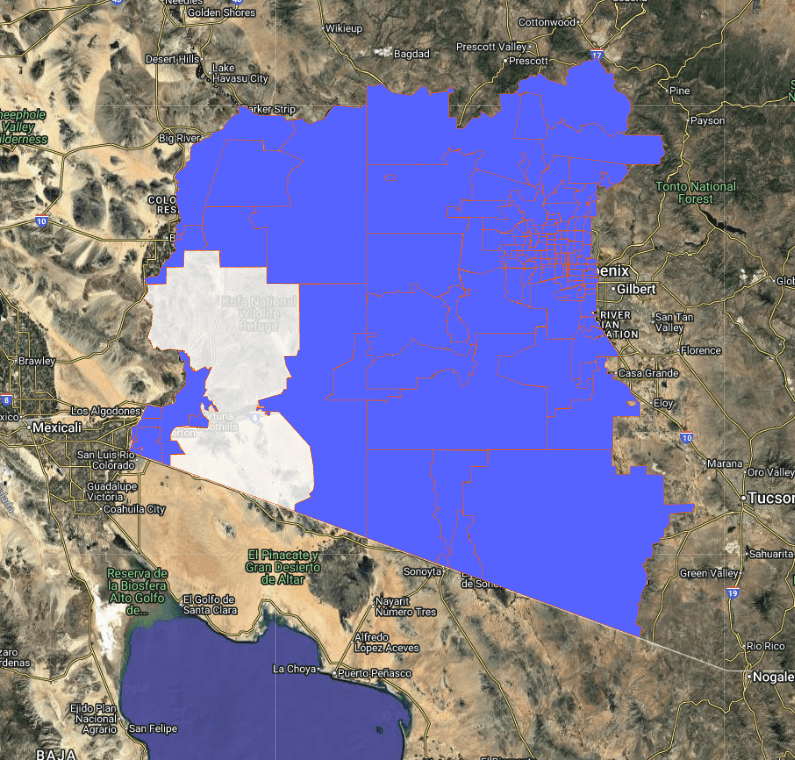
Why It Matters
Insurance carriers face state-by-state regulations, appointment requirements, and compliance obligations that make territory design uniquely complex. Without the right data and tools, insurers risk overlapping agent footprints, poor coverage, and missed growth in high-potential ZIPs and counties.









How insurance territory mapping works in practice
Insurers balance risk exposure with fair market opportunity for agents and brokers. Legacy boundaries and dated census tables often miss current shifts in population and income. Population Explorer provides a self-serve workflow to build accurate, defensible territory maps for your insurance operations.
Define or import territories - Draw new polygons or upload existing agent assignments to create a 'master insurance territory map' where you can compare population and POI coverage.
Layer risk drivers and demand - Use LandScan and WorldPop demographics, income layers, and Google Places POIs to assess population density, commuting corridors, and commercial hubs, fine-tuning your territory maps accordingly.
Export for operations - Generate ZIP lists, shapefiles, and formatted reports for compliance, licensing, and CRM integration.
For inputs and orientation, see About Our Data and Start Here.
FAQs every insurer asks
How do territories affect risk concentration?
Well-designed insurance territory boundaries prevent overexposure to high-density areas and support balanced underwriting portfolios.
Can I assess exposure using demographic shifts?
Yes. Annual LandScan and WorldPop updates capture growth corridors and declining regions for property, auto, and liability lines. Read more about our data. Rank and filter your insurance territories using our search/filter function to identify higher risk components of your portfolio.
How do territories support compliance?
Population Explorer exports ZIP-based lists and shapefiles aligned with regulatory workflows. Create robust, compelling maps annotated with high resolution demographics and POIs.
Can I analyze agent opportunity by income or households?
Yes. Income distributions indicate purchasing power; household counts measure addressable market. See How to Measure Population Near a Site. Map a prospective territory in seconds, identify underlying demographic dynamics and update your agent assignments accordingly.
Does the platform help with catastrophe or climate modeling?
PopEx doesn't model climate directly; teams can overlay our demographic baselines with third‐party hazard maps.
Will this scale for national or global insurers?
Yes. LandScan and WorldPop provide global coverage for consistent frameworks across markets, and a standardized master territory map for agents.
Can I integrate agent or policy data?
Yes. Import CSVs with agent or policy counts to benchmark territory size. See Importing CRM Accounts.
How current is the data compared to census?
Census releases can lag by years. PopEx refreshes annually and includes projections to keep planning current.
Why census data can misrepresent insurance risk
Census datasets may miss suburban expansion, urban infill, or migration patterns that affect claims exposure. A territory drawn on old tables can understate today's density and skew loss ratios.
Population Explorer mitigates this with annual demographic refreshes via LandScan and WorldPop, plus Google Places POIs to reflect real‐time changes in residential and commercial distribution. See Census vs LandScan vs WorldPop.
Benefits of a self-serve approach over consultant maps
Static, consultant-delivered maps quickly fall out of date. A self‐service workflow lets actuarial, distribution, and compliance teams collaborate directly.
Agility - Rebalance territories as policies grow or regulators require updates.
Cost savings - Reduce repeat consultant spend.
Accuracy - Use refreshed LandScan, WorldPop, and Google Places datasets.
Transparency - Provide agents and regulators with defensible, data-backed territories.
Comparing approaches to insurance territory mapping
For insurance territory mapping, methods vary in reliability and maintenance cost:
Census-based resellers - High lag; weak fit for current risk assessment or demand forecasting.
Consultant PDFs - Static, often not regulator-ready without reformatting.
Internal spreadsheets - Flexible but error‐prone and weak on geospatial accuracy.
Population Explorer integrates global LandScan and WorldPop demographics, income and household layers, and Google Places POIs in one platform. Outputs are export-ready for compliance and CRM. For onboarding, see Start Here.