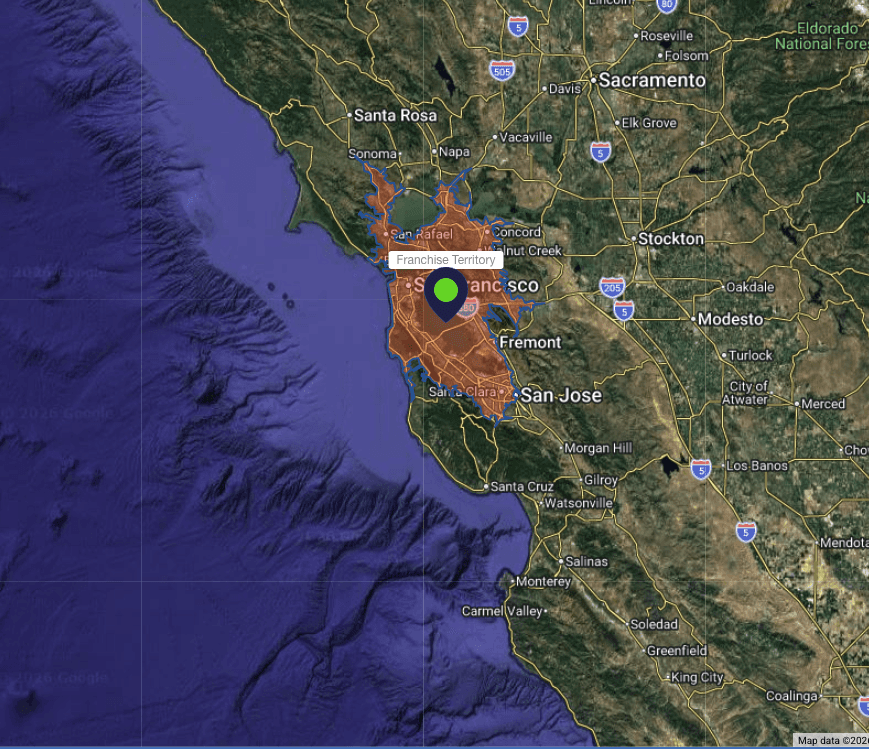
Franchise Territory Mapping Strategies: a brief primer
Franchise territory mapping, as a science, emerged as brands expanded into increasingly competitive and fragmented markets.
Selling one territory across a large geography rarely requires much precision. But as a brand expands - selling more units into tighter, more competitive markets - valuation questions naturally arise. Which markets are stronger? Which territories deserve higher valuations? Which geographies can realistically support additional locations without creating operational or competitive strain?
And as with many disciplines that evolved reactively rather than systematically, methodologies, priorities, and outputs vary widely across franchisors and brands.
One system may rely heavily on population counts. Another may prioritize traffic visibility and customer accessibility. Another may focus on household income thresholds, historical performance, or existing store spacing rules. Internationally, things become even more fragmented. Datasets vary dramatically by country, population reporting standards differ, and some regions have very limited reliable commercial market data available at all.
Franchisors and franchisees both pay dearly for these fractured datasets and inconsistent methodologies. Together, they limit visibility into the relative performance potential of one geography versus another. Which means that, at best, major expansion decisions are being made with incomplete visibility. At worst, territories are being valued and sold based on assumptions that cannot easily be validated. In either case, uncertainty expands drastically.
Further complicating the matter, FDD Item 12s rarely disclose those methodologies in meaningful detail, but the franchisee will still be expected to pay for the territory. Which, in many cases, leaves franchisees (and franchisors) asking obvious questions about the valuation process:
What data was used?
How recent was it?
Were territories built around residential population, daytime population, drive-times, or simple radius distances?
How were competitors considered?
How were future growth trends incorporated?
Were territories designed around customer accessibility, operational efficiency, or simple spacing rules?
In many cases, franchisees and consultants are expected to trust the territory structure without fully understanding how it was developed in the first place.
And the stakes are high.
Why Territory Quality Matters So Much
A franchise territory gives geographic definition to your primary marketplace.
It determines which customers you can realistically compete for, how much spending power exists within reach of the business, how far customers must travel to access your product or service and how much competitive pressure exists between your business and the customer itself.
It is difficult to imagine a stronger structural determinant of long-term business performance. Your territory will comprise your greatest opportunity and your greatest risk.
Business schools and expansion strategists have been circling this idea of ‘territory quality’ for decades through various playful euphemisms: “selling ice cubes to Eskimos,” “carrying coals to Newcastle,” and other illustrations of dysfunctional trade areas. The underlying message is clearly and widely known: market success is borderline impossible in a fundamentally weak territory. Even exceptional brands will struggle inside territories with insufficient demand, weak accessibility, low spending power, or overwhelming competitive saturation.
Why should this matter to franchisors and franchisees? Because territory commitments are long term: once boundaries are established, and operational expectations are set, changing territory structures can become politically and commercially difficult.
How does it work in practice? (or how should it work?)
Identifying and demarcating a competitive franchise territory requires careful consideration of multiple variables - and often consultation with site-level experts, brokers, consultants, and local operators. One of the most common mistakes in franchise territory planning is assuming there is a single “perfect” solution. There is not.
Franchise Territory Mapping Software
As we have discussed in other articles, there are three fundamental market forces that consistently shape territory performance. Miss these, and even otherwise promising markets can struggle. Understand them well, and you can dramatically improve the quality of your expansion decisions. And for these foundational layers of analysis, most franchisors and franchisees can access a wide range of SaaS platforms and commercial datasets capable of supporting meaningful territory evaluation. Many of these tools provide non-technical users access to surprisingly robust analytical workflows.
The goal with these systems is not to become an expert market analyst or advanced GIS technician. It is simply to develop enough visibility into a market to validate core assumptions, compare competing geographies and, in general, better understand the commercial dynamics shaping a territory’s long-term potential.
These insights will give you a tremendous lift: if you can independently validate basic market fundamentals, you are already operating with more visibility than many franchisees signing off on FDD Item 12 territory structures.
The role of consultants and ‘local’ intelligence
Realistically, these toolsets are not the end of the story. Once strong candidate territories have been identified, site-level evaluation becomes the next major layer of focus. And at this stage, most operators will still need support from commercial real estate professionals, zoning authorities and, indeed, will likely need to spend time on-site to personally assess market capabilities of varying locations.
There are almost no SaaS platforms or AI systems capable of fully replacing real-world site evaluation. Choosing where exactly to build within a validated, competitive territory requires an assessment of visibility, accessibility, traffic patterns and countless other operational realities that rarely appear in remote datasets.
What can you realistically do yourself?
Quite a bit, actually
Not every franchise brand needs a dedicated analytics team to pick a high performance territory. Most operators can validate far more than they realize, and for a fraction of the cost one might expect from legacy market research firms.
Over the past decade, territory analysis tooling has become dramatically more accessible. Tasks that once required GIS specialists, consultants or expensive demographic reports can now often be performed through relatively approachable SaaS platforms and commercial datasets.
Today, franchisors, consultants and franchisees can independently evaluate a surprisingly wide range of market characteristics, including population density and forecasts, daytime population activity, drive-time territory analysis, competitor research, economic research and a host of other crucial indicators. This provides a significant strategic advantage: a franchisee who can independently compare territories, validate customer concentration and evaluate competitive saturation is operating with substantially more visibility - and thus risk management capabilities - than someone relying entirely on high-level summaries, external consultants or randomly selected geographic boundaries.
But be mindful of the data…
At the same time, it is important to understand that not all datasets, or territory analysis systems, are built equally. Some platforms still rely heavily on static census products aggregated into large geographic units. Others incorporate modeled population systems, higher-resolution demographic surfaces, mobility-aware trade areas or commercial business databases. Internationally, the differences become even more pronounced, as market standardization varies dramatically from country to country.
These differences matter. Two territory evaluation systems using different population models, trade-area methodologies or business datasets can produce meaningfully different interpretations of the exact same geography. Which means understanding the limitations of the underlying data is just as important as understanding the outputs themselves.
For example:
a census-based system may miss smaller growth corridors or rapidly changing suburban development
incomplete business databases may underestimate competitive pressure
and residential population alone may fail to capture daytime commercial demand
This does not mean modern self-service analysis lacks value. Quite the opposite. With a basic understanding of the underlying datasets, their strengths and weaknesses, franchisors and franchisees can independently validate the core market fundamentals shaping territory performance long before committing capital.
Key Considerations in Franchise Territory Strategy
There are a great many factors that influence optimal franchise territory design. Below are three of the more important to help you frame your go-to-market strategy.
1 - Market fundamentals that shape territory performance
There are three fundamental market forces that will dictate territory performance, regardless of the continent or country your franchise operates in:
Customer Density
Economic Strength
Competitive Pressure
Understanding these forces does not guarantee success. But misunderstanding them almost guarantees structural weakness. And these forces almost always work together, meaning you cannot simply take one and ignore the other two. All three must be considered simultaneously. For example, a territory with a large population may perform poorly. A wealthy territory may lack sufficient customer volume. A territory with both strong demographics and high income may already be heavily contested by competitors.
Territory mapping is rarely about optimizing a single metric. Instead, strong territories typically emerge where all three forces align: a sufficiently large customer base, economic conditions that support the concept and competitive conditions that still leave room for growth. And so the role of territory mapping and analysis is to identify where these conditions overlap, or to find the territory that has comparative advantages along one or more of the metrics.
2 - Unique territory mapping strategies for Inbound and Outbound Franchise Models
Within franchise territory mapping strategies, inbound and outbound models obey very different geographic constraints. A territory that performs exceptionally well for an inbound franchise model may be fundamentally broken for an outbound concept, even when both are operating within the exact same geography.
This is because the mechanics of customer acquisition are different. Some businesses require customers to travel toward the business - inbound. Others require the business to travel toward the customer - outbound. And, primarily because customers almost always prioritize convenience when given two equal options, this makes ‘population within reach’ a fundamental driver for inbound territory evaluation; less so for outbound.
Inbound Franchise Models
Inbound businesses depend on customers physically traveling to the business location.
Examples include:
restaurants
fitness centers
coffee shops
medical clinics
retail stores
and most consumer-facing franchise concepts
In these models, convenience becomes a dominant market force. Customers overwhelmingly gravitate toward the options that are easier to access, faster to reach or more visible. And this is why territory evaluation cannot stop at simple population counts, especially for inbound models.
A territory may contain a large population dispersed over a wide geographic area, while still performing poorly because customers are separated by:
congestion
weak transportation infrastructure
inconvenient traffic flows
physical barriers
or simply inefficient travel patterns
Similarly, geographic distance is a misleading indicator for inbound franchise models. A one-mile radius may represent a 5-minute travel commitment in some suburbs, whereas in others it may require an hour.
To account for this ‘convenience factor’, inbound territories must assess travel-time trade areas (isochrones) to measure the reachable customer base.
Outbound Franchise Models
Outbound businesses operate under a very different set of geographic constraints. In these systems, the business travels to the customer.
Examples include:
HVAC
roofing
pest control
commercial cleaning
mobile repair
home services
and many B2B service concepts
Customer convenience still matters. But accessibility behaves differently because the customer is no longer responsible for the majority of the travel burden. Operational efficiency becomes the dominant constraint instead.
Which means territory evaluation increasingly shifts toward:
technician routing
service density
travel time per visit
labor distribution
transportation costs
scheduling efficiency
and operational scalability
This distinction matters because a territory with strong raw population counts can still become operationally inefficient if customers are geographically dispersed. Under these conditions, the ‘visits-per-hour’ metric could suffer. On a similar note, hyper-dense geographies which might suffer from traffic congestion or other delaying factors, would also be unattractive: anything which could reduce the amount of sales calls or service visits technicians can reasonably serve should be avoided.
3. Network-Level Considerations
Territories also need to be evaluated in the context of the broader franchise network.
A territory that looks strong in isolation may become less attractive once nearby units, future expansion plans and internal overlap are taken into account. This is especially true for growing franchise systems, where the question is not simply whether one location can succeed, but whether the surrounding market can support a larger network over time.
Cannibalization
Every new territory added to a franchise network changes the economics of the territories around it. One of the most common risks in territory expansion is cannibalization. This occurs when a new territory draws from the same customer base as an existing unit, resulting in revenue being redistributed across the network rather than creating meaningful incremental growth. The problem is particularly common in dense urban markets where customer catchments overlap, travel-times are short and multiple locations compete for the same pool of customers.
For franchisors, cannibalization creates a difficult balancing act. Territories must be large enough to provide franchisees with a realistic opportunity to succeed, but not so large that future expansion opportunities are unnecessarily restricted, which is what we will cover in the next section.
Oversizing Territories
But the opposite problem is also common. A territory can be too large. If one franchisee receives a broad geography that contains several distinct customer clusters, the franchisor may leave future unit growth on the table. Large protected territories can make early sales easier, but they can also lock away valuable expansion opportunities that may be difficult to recover later. By creating oversized territories, franchisors and brands leave potential revenue on the table.
Optimal territory strategy involves balancing protection and flexibility, avoiding the twin pitfalls of cannibalization and oversizing. Franchisees need enough market opportunity to justify their investment. Franchisors need enough room to build a coherent network as the brand grows. The best territory structures usually account for both.
Reverse Engineering Successful Territories
Brands often take a shotgun approach to market expansion, particularly in the early growth stages. Try every territory, every metro, copy your competitors, everything. And this is warranted to a degree: no amount of market research can substitute for the hard, direct feedback of a customer experience. You need to put your concept in front of as many people as possible, in as many different marketplaces as possible, to really begin to understand which types of markets suit your concept the best.
And once you’ve found a strong market, you can reverse engineer its characteristics to narrow down your expansion strategy. You work backward from the system’s strongest existing units. Rather than beginning with a blank map, franchisors can study their best-performing locations and ask what those markets have in common. Do they share similar daytime population patterns? Similar residential density? Similar household income levels? Similar competitor density? Similar access to commercial corridors or complementary businesses?
Once those characteristics are understood, they can become a screening framework for future expansion. The goal is not to find identical markets, because no two territories are exactly alike. The goal is to identify the market conditions that appear repeatedly in successful territories, then use those patterns to evaluate where the next strong territories are most likely to exist.
Closing Thoughts
Modern territory analysis tools have made franchise territory design significantly more accessible and efficient. Today, franchisors, consultants and franchisees can independently assess customer density, economic strength and competitive pressure using a wide range of demographic, economic and business-location datasets. At the same time, not all datasets are created equally. Different platforms rely on different population models, trade-area methodologies and commercial databases, making it important to understand the strengths and limitations of the underlying data.
Using these datasets and tools to help answer critical questions about territory strength - whether the market is strong or weak, the type of map that best suits your franchise model (inbound vs outbound) and the optimal territory profile for your brand - will bring a great deal of confidence and transparency to your expansion plans.
Equally important, software cannot fully replace local knowledge. Site visits, operational experience, commercial real estate expertise and local market intelligence remain valuable components of any territory strategy. The objective is not to eliminate uncertainty entirely, but to reduce it as much as possible before making long-term expansion decisions. In the next article, we'll move from strategy to execution and explore practical techniques for evaluating, comparing and validating franchise territories firsthand.
How to Build a Franchise Territory
In our next guide, we'll walk through a practical framework for selecting the right type of boundary for your growing franchise network.
→ How to choose the right boundary type for your franchise territory
Not sure whether a territory is strong enough to support another location?
Send us up to five candidate territories and we'll provide an independent review of customer density, economic strength, competitive pressure and market coverage. Free.
→ Submit a Territory for Review